
2016 PETCO Awards recognise extraordinary PET recycling achievements
The noteworthy contributions of individuals, companies and organisations to the recycling of post-consumer Polyethylene Terephthalate (PET) in South Africa during the course of 2015 were recognised and celebrated at PETCO’s Annual General Meeting (AGM). The prestigious awards ceremony took place at the Venue Green Park in Sandton, on 21 July 2016.
“At PETCO, we believe that our greatest asset is our network of partners – those that give up their free time and work long hours, to get the job done,” says PETCO CEO, Cheri Scholtz. “As such, we are delighted to be able to recognise the significant efforts made by our 13 worthy award winners towards the recycling of post-consumer PET in South Africa.”
The PETCO awards were initially established to recognise those individuals and companies that contribute significantly to advancing PET recycling, whilst reflecting the principles of Extended Producer Responsibility and circular economy-thinking in their practices. This year’s awards, which formed part of the company’s 11th AGM, confirmed that a significant milestone had been reached in 2015.
In its latest results for 2015, PETCO reports that the organisation recycled an additional 15% of post-consumer bottles in comparison to the previous year, with the total PET market growing by 8.5% to 210 000 tonnes. An annual PET recycling rate of 52% of post-consumer bottle PET was achieved and, for the first time, PETCO recycled more bottles than those going into landfill.
Scholtz continues: “This is an extremely proud accomplishment for PETCO, but we could not have achieved this without the people, companies and organisations we work with that have made remarkable contributions to the recycling of post-consumer PET in South Africa.”

[Photo Caption] Cheri Scholtz, PETCO CEO, and Casper Durandt, Technical Manager of Coca-Cola South Africa, at the PETCO awards ceremony. Coca-Cola South Africa received the ‘Designed for Recycling’ award for their extensive range of bottles that have been designed with recycling in mind. [Photo Credit: Dominic Barnardt]
The 2016 PETCO awards acknowledged a wide range of achievements, from recognising products that have been designed with recycling in mind, to the best product using recycled PET (or rPET), to the best female entrepreneur within the PET value chain, whose perseverance has created and sustained a successful, growing business venture in PET collection or recycling.
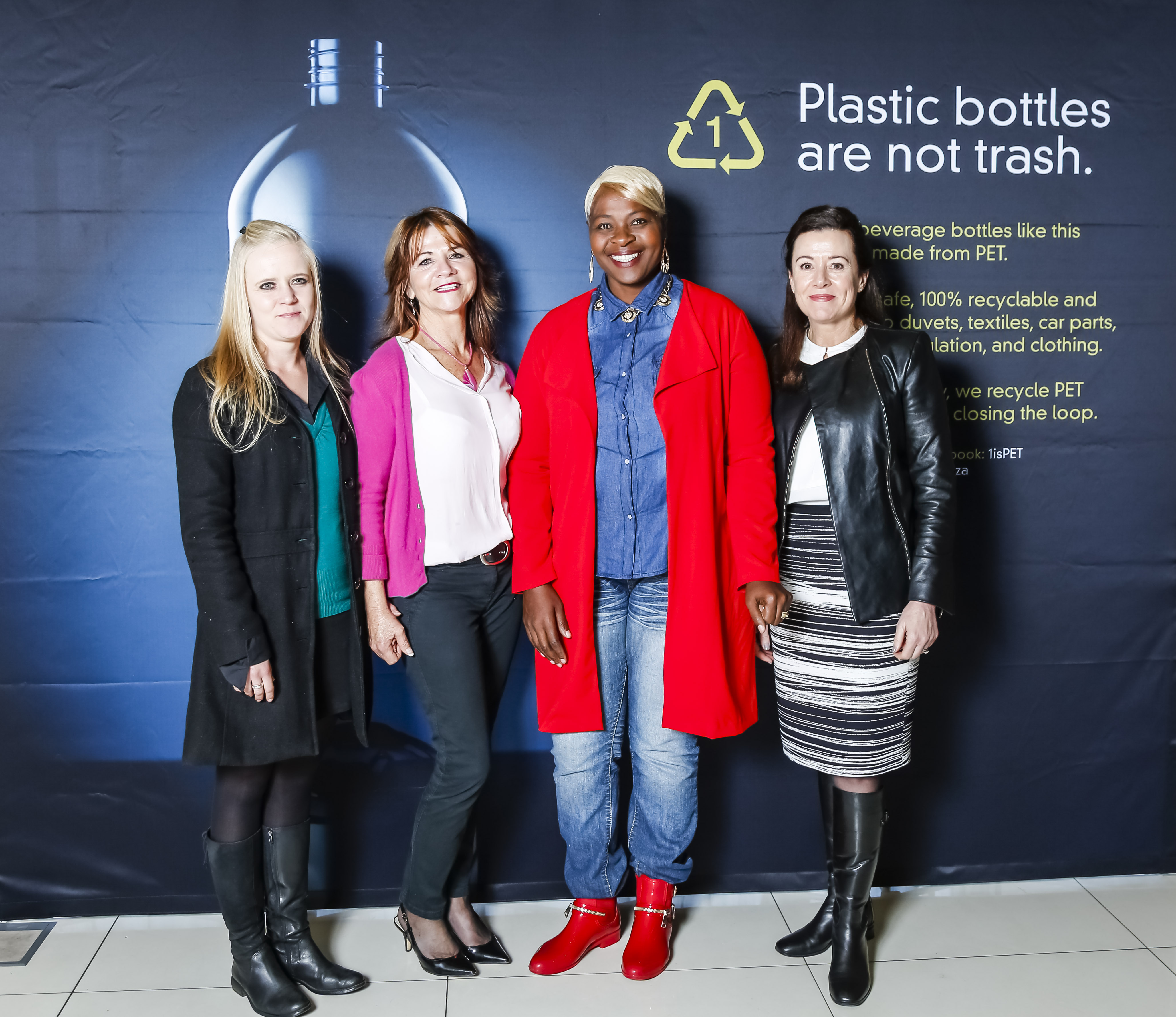
[Photo Caption] The Women PET-trepreneur award winners, Megan Leach from Envirowaste Recyclers, and Nomlindelo Modisang from Lindithando Construction & Projects, at the PETCO awards ceremony. (From left to right: Megan Leach, Belinda Booker, PETCO Collections and Training Manager, Nomlindelo Modisang and Cheri Scholtz, PETCO CEO) [Photo Credit: Dominic Barnardt]
Three of the categories boasted more than one winner.
Explains Scholtz, “We were so impressed with our nominees this year that, in some instances, choosing between them for a clear winner was impossible. Instead we chose to highlight all the nominees as, besides their contributions to PET recycling, they all work tirelessly to uplift the communities within which they operate – which we believe is worth celebrating.”
The key role that government plays within the PET recycling sector was specifically highlighted through the PET Recycling Local Authority Initiative award.
“PETCO recognises the important role that government and its municipalities have to play in providing an enabling regulatory environment for effective waste management. We applaud Lephalale Municipality for their exemplary quality of service delivery around waste management and recycling, and believe their efforts can be used as a model for other municipalities to follow,” adds Scholtz.
The 2016 PETCO Award winners are:
- Best Recycling Information, Awareness and Education Programme, Gregory Player from Clean C, Cape Town;
- Best Product using recycled PET (rPET), Woolworths Holdings Limited;
- Best Product that has been ‘Designed for Recycling’, Coca-Cola Southern Africa;
- PETCO Recycling Champion, Kimberley Recycling (Kimberley);
- PET Community Outreach and Upliftment award, shared by K1 Recycling (Katlehong), WasteWant (Elsies River, Cape Town), and the PEACE Foundation (Polokwane);
- Woman PET-trepreneur, shared by Megan Leach from Envirowaste Recyclers (Welkom), and Nomlindelo ‘Pinky’ Modisang from Lindithando Construction & Projects (Walkerville);
- PET-trepreneur, shared by Gcina Makhoba from Mpilenhle Recycling (Mpilenhle), and Brian Masemola from Boremako Recycling (Pretoria);
- PET Recycling Local Authority Initiative, Lephalale Municipality, Lephalale; and
- PETCO’s Small- Medium-sized Business Champion, Cannibal Recycling, Port Elizabeth.
“PETCO believes the future of South Africa will be shaped by individuals such as these who have received awards here today; passionate, committed people who are led by intuition and fed by imagination as they re-write the rules, whilst creating a better South Africa for us all,” concludes Scholtz.
For more information on PETCO, visit http://www.petco.co.za. For more information on the nomination process for the 2017 PETCO Awards, email janine.basson@petco.co.za.

Stop being taken for a PR ride
Stop being taken for a ride by your public relations (PR) company or ‘social media agency’ and stop throwing exorbitant amounts of money at communication efforts that are not well planned or strategically sound. A press release is not a silver bullet that is going to magically solve your sales problems, nor is a beautiful Facebook page.
“When it comes to your organisation’s reputation, every aspect of the business contributes to how it is being perceived. Perceptions may not necessarily be correct, however they are somebody’s reality and do need to be managed,” says Regine le Roux, Managing Director of Reputation Matters.
“Only once you understand exactly what these perceptions are, and which areas of the business is important to which stakeholder groups can you effectively put a reputation management strategy and communication plan in place,” explains le Roux.
“Too often business owners think that a clever press release or quirky marketing campaign is going to increase their sales. You can spend a ton of money on a fancy communication campaign but if your internal business building blocks are not in place, you may actually do a lot more harm than good,” adds le Roux. These building blocks, explains le Roux, include having the right processes, people and pricing principles in place; all of which needs to be glued together by a strategic internal and external communication plan.
Le Roux will be presenting a reputation management master class at the upcoming International Association of Business Communication (IABC) conference taking place at the Vineyard in Cape Town on 02 November 2016. She will be facilitating an interactive workshop on what it takes to enhance and improve your reputation, and will guide delegates on how to develop their own reputation strategies and plans. “After the session the delegates will have a very comprehensive idea of what they need to do to take their company’s reputation to the next level,” adds le Roux.
“Collaboration and agility is the new communication frontier in business,” says Carol Allers, IABC Chairperson. “At the conference we’ll be bringing together thought leaders from across the communication spectrum to engage, collaborate, network and most importantly to share their knowledge of business communication,” concludes Allers.
The IABC Conference will be taking place from 02 to 04 November 2016 at the Vineyard Hotel and Spa in Cape Town. For more information about the Conference visit: http://www.iabc.co.za/2016/02/17/iabc-africa-23rd-annual-conference-2016-registrations-are-now-open/
For more about managing your reputation visit www.reputationmatters.co.za Join the reputation conversation on Twitter @ReputationIsKey and Facebook www.facebook.com/yourreputationmatters.
Humanising cities – is it possible?
South Africa’s building landscape is soaring: the value of building plans in the private sector increased by 3.3% in 2015*. Simultaneously, architects’ roles are changing; they have to reinvent themselves in terms of the kinds of projects they undertake, the sorts of businesses they run, in how they relate to each other, in the reaerch they do. That all of this takes place in relation to accelerating urbanisation, goes without saying: it is estimated that by 2050, 80% of South Africa’s population will live in urban areas**. “Architects play an integral role in shaping and planning the cities of tomorrow,” says Obert Chakarisa, Chief Executive Officer of the South African Institute of Architects (SAIA).
Humanising cities is crucial in the architectural profession, and scaling and planning are of the utmost importance.
SAIA will once again co-host the creative and diverse architecture and design festival, ArchitectureZA 2016 (AZA16). AZA16 takes place from 31 August to 03 September 2016 at the University of the Witwatersrand (Wits) in Johannesburg. “The festival will delve into the theme, ‘SCALE’, how it transcends professions as well as the endless array of interpretations it manifests,” mentions Chakarisa.
Hannah le Roux, Associate Professor and Director of the Architecture Programme at Wits says, “Scale is not a concept limited to planning, urban design or architecture. It transcends these borders. Scaling up and down is intrinsic to the craft of architecture and spatial practice.”
At AZA16, international and local experts will explore topics ranging from the effects of big data on complex design ecologies, systems and territories, to the intimacies of crafted detail and local communities. “We’re going to examine how architects and other designers work across scales, how they handle ‘bigness’ and ‘smallness', and how the micro and the uber intersect,” says Catherine de Souza, AZA16 conference programmer.
In the last century of architectural practice, different scales have increasingly fallen into different professional camps. The interdependence of scales, whether in terms of physics, ecology or transnational cultural manifestations, has become more prevalent and is gaining recognition in our modern society. “In reality, scale is collapsing, making the nano global, and beyond, more knowable to all,” explains le Roux.
Scale is a uniquely challenging concept in the architectural and interior design professions. It is intrinsic to indigenous African practice, whether in the abundance of fractal patterns or the configuration of dwelling spaces, and yet it needs to fit with global scalar practices. It is also important for business, as the relationship between the single maker and networks of production becomes ever more fluid.
“It is not just about how much space is available in a room or on a plot of ground,” says le Roux. “It is so much more: how to design a dwelling unit that repeats over twenty floors; how to mediate the experience of individual visitors at a hotel or conference with the logistics of food chains; how to insert a tiny, exquisite narrative into a vast cultural landscape; how to make an urban gesture that helps to humanise a city of cars and taxis; and how to place the informal in the formal, and the formal in the informal,” she explains.
Where different types of design intersect, architects must remain flexible. They must be able to work with whatever scale is necessary to create meaning in a piece of space – working across all scales.
“Scaling up or scaling down is an inherent skill in architecture. Those who work in the profession must understand how the ‘bigness’ of a city or national culture works together with the ‘smallness’ of a single building or individual,” says le Roux.
AZA16 calls for the generalists, the big thinkers and the detail-focused to converge, share ideas, learn from one another and better understand where the profession is headed. The AZA16 festival is a learning and networking event that should not be missed.
AZA16 is a SAIA event and co-hosted with the University of the Witwatersrand. For more information about AZA16, visit http://architectureza.org/. Join AZA on Facebook at https://www.facebook.com/architectureza/.
*http://www.statssa.gov.za/publications/P50413/P504132015.pdf
**http://www.bdlive.co.za/national/2015/05/26/sas-urban-population-growing-larger-and-younger
Humanising cities – is it possible?
South Africa’s building landscape is soaring: the value of building plans in the private sector increased by 3.3% in 2015*. Simultaneously, architects’ roles are changing; they have to reinvent themselves in terms of the kinds of projects they undertake, the sorts of businesses they run, in how they relate to each other, in the reaerch they do. That all of this takes place in relation to accelerating urbanisation, goes without saying: it is estimated that by 2050, 80% of South Africa’s population will live in urban areas**. “Architects play an integral role in shaping and planning the cities of tomorrow,” says Obert Chakarisa, Chief Executive Officer of the South African Institute of Architects (SAIA).
Humanising cities is crucial in the architectural profession, and scaling and planning are of the utmost importance.
SAIA will once again co-host the creative and diverse architecture and design festival, ArchitectureZA 2016 (AZA16). AZA16 takes place from 31 August to 03 September 2016 at the University of the Witwatersrand (Wits) in Johannesburg. “The festival will delve into the theme, ‘SCALE’, how it transcends professions as well as the endless array of interpretations it manifests,” mentions Chakarisa.
Hannah le Roux, Associate Professor and Director of the Architecture Programme at Wits says, “Scale is not a concept limited to planning, urban design or architecture. It transcends these borders. Scaling up and down is intrinsic to the craft of architecture and spatial practice.”
At AZA16, international and local experts will explore topics ranging from the effects of big data on complex design ecologies, systems and territories, to the intimacies of crafted detail and local communities. “We’re going to examine how architects and other designers work across scales, how they handle ‘bigness’ and ‘smallness', and how the micro and the uber intersect,” says Catherine de Souza, AZA16 conference programmer.
In the last century of architectural practice, different scales have increasingly fallen into different professional camps. The interdependence of scales, whether in terms of physics, ecology or transnational cultural manifestations, has become more prevalent and is gaining recognition in our modern society. “In reality, scale is collapsing, making the nano global, and beyond, more knowable to all,” explains le Roux.
Scale is a uniquely challenging concept in the architectural and interior design professions. It is intrinsic to indigenous African practice, whether in the abundance of fractal patterns or the configuration of dwelling spaces, and yet it needs to fit with global scalar practices. It is also important for business, as the relationship between the single maker and networks of production becomes ever more fluid.
“It is not just about how much space is available in a room or on a plot of ground,” says le Roux. “It is so much more: how to design a dwelling unit that repeats over twenty floors; how to mediate the experience of individual visitors at a hotel or conference with the logistics of food chains; how to insert a tiny, exquisite narrative into a vast cultural landscape; how to make an urban gesture that helps to humanise a city of cars and taxis; and how to place the informal in the formal, and the formal in the informal,” she explains.
Where different types of design intersect, architects must remain flexible. They must be able to work with whatever scale is necessary to create meaning in a piece of space – working across all scales.
“Scaling up or scaling down is an inherent skill in architecture. Those who work in the profession must understand how the ‘bigness’ of a city or national culture works together with the ‘smallness’ of a single building or individual,” says le Roux.
AZA16 calls for the generalists, the big thinkers and the detail-focused to converge, share ideas, learn from one another and better understand where the profession is headed. The AZA16 festival is a learning and networking event that should not be missed.
AZA16 is a SAIA event and co-hosted with the University of the Witwatersrand. For more information about AZA16, visit http://architectureza.org/. Join AZA on Facebook at https://www.facebook.com/architectureza/.
*http://www.statssa.gov.za/publications/P50413/P504132015.pdf
**http://www.bdlive.co.za/national/2015/05/26/sas-urban-population-growing-larger-and-younger
PETCO celebrates 12 years of consistently growing PET recycling tonnages
In celebration of PETCO’s 12th year of operating in the Polyethylene Terephthalate (PET) plastic recycling industry, key role-players in the industry are invited to save the date for the 11th PETCO AGM taking place on Thursday, 21 July 2016 from 11:00 to 15:00 at The Venue Green Park, Sandton. As part of the AGM proceedings, PETCO will also be hosting their PETCO Awards, the aim of which is to honour individuals, businesses and organisations that played a significant role in the PET recycling value chain in South Africa during the course of 2015.
“PETCO is delighted that for the eleventh successive year, the post-consumer PET bottle-recycling rate has increased, despite two of the biggest falls in oil prices seen in recent years,” says CEO Cheri Scholtz. “The 1.7 billion PET bottles that were collected across South Africa in 2015, which equates to approximately 4.7 million bottles collected each and every day, sustained over 50 000 income opportunities.”
In its latest results for 2015, PETCO reports that the organisation recycled an additional 15% of post-consumer bottles in comparison to the previous year, with the total PET market growing by 8.5% to 210 000 tonnes. An annual PET recycling rate of 52% of post-consumer bottle PET was achieved and, for the first time, PETCO recycled more bottles than those going into landfill.
Scholtz continues: “While this is an extremely proud accomplishment for PETCO, we could not have achieved this without the people, companies and organisations we work with that have made extraordinary contributions to the recycling of post-consumer PET in South Africa.”
The PETCO Awards, which will form part of PETCO’s 2016 Annual General Meeting (AGM), have specifically been created to recognise and celebrate stakeholders in the PET value chain for their commitment and contributions to advancing the PET recycling industry.
“The 2016 PETCO Awards is all about celebrating the great innovations, achievements and contributions made by individuals and organisations towards PET recycling within South Africa’s PET sector,” concludes Scholtz.
Media RSVP to De Wet Bergh on 081 439 3912 or dewet@reputationmatters.co.za by no later than 16:00, 19 July 2016.
For more information about the PETCO AGM and Awards, contact PETCO on info@petco.co.za.
Improving life through art and music

The National Children and Violence Trust (NCVT) commemorated and concluded Youth Month this year by focussing on recruiting more children for its youth based programmes. “The NCVT ‘Healing Through Art’ initiative has been running since February 2015 and the Youth Choir since December 2015; involving more than 12 unemployed youth from around Diepsloot, Lanseria, Zandspruit, Itsoseng and Cosmo City,” says NCVT Senior Social Worker, Nokwazi Dlamini. “We invested in the two youth programmes to empower, educate and entertain our children and believe that they will learn valuable life lessons by participating,” she adds.
Art Therapy is a form of psychotherapy that uses art media as its primary mode of communication. It is a well-established form of therapy in other areas such as the United Kingdom, however, is a relatively new practice in South Africa. Art-making is largely able to transcend language and cultural barriers, so it is particularly appropriate in the South African context.* Music on the other hand, may also be used as a medium to treat depression and bring a sense of joy. Evidence has shown that music therapy can address people’s physical, emotional, cognitive, and social needs as they either create, sing, move to, and/or listen to music.**
“Many young people succumb to social injustices by resorting to a life of crime and substance abuse as a solution for better living conditions. Unfortunately this always ends badly – either in prison or worse, a life lost,” says Dlamini. “Joining the choir helps us stay motivated and focused on our dreams and goals,” says Tshepo Pelembe, member of NCVT choir. “Since joining the choir, I have made new friends and feel more confident in my abilities and talents,” he adds.
Participants in both programmes have either improved academically at school or are able to engage more with their peers and have become more socially involved within their communities. “Involving more youth in our programmes means raising an inspired generation that will bring positive change to combat any social stigmas concerning youth from impoverished areas. We commend our children’s parents for being so supportive of the youth that form part of our programmes,” concludes Dlamini.
NCVT encourages young people to actively participate in community outreach programmes and other empowering extra mural activities. The Youth Choir can be found performing at NCVT events and other local events in the surrounding areas in which NCVT operates.
To join the NCVT Youth Choir, participate in the ‘Healing Through Art’ initiative or make donations to NCVT or volunteer, members of the community can contact ncvtprojects@iafrica.com | +27 11 705-1960 | +27 11 467 4936. For more about NCVT, please visit www.ncvt.co.za.
* http://www.cath.co.za/therapy.php
###
Released by Reputation Matters
Media contact:
Morongoa Mohloba
Mobile: 081 411 6089
Email: morongoa@reputationmatters.co.za
About The National Children and Violence Trust
The National Children and Violence Trust (NCVT) is a non-profit organization (NPO) that functions to support vulnerable groups such as abused and violated children, women, the unemployed, people infected and affected by HIV/AIDS in some of the most impoverished informal settlements within Gauteng. These areas include Diepsloot, Lanseria, Zandspruit, Itsoseng and the new settlement of Cosmo City.
Is there real value in having a vision?
Management courses are never complete without a discussion of visions, missions, objectives and goals, however do leaders of companies really know how impactful a clearly defined strategic intent can be on their business’ reputation?
Founder and Managing Director of Reputation Matters, Regine le Roux is certain that while some corporates may consider business values as ‘stale’ or going out of fashion, they are critical for good reputation management. “All businesses must have a vision that is translated into a meaningful mission, objectives and specific goals. It is the first business building block to know what the business is about and where it is heading towards.”
Le Roux warns that the important link between strategic intent and reputation should not be overlooked. “Employees play a fundamental role in a business’ strategic intent as their work contributes towards achieving the vision, making it critical to communicate this to employees.”
Having sat around many a boardroom table discussing strategic intent, le Roux has far too often seen executives become confused when finding that they all have a different version of the business vision. “It goes without saying that this type of confusion has a major impact on the ultimate reputation of the organisation. When internal perceptions are misaligned and employees don’t know the vision of the business, how are they supposed to help achieve it?” she asks.
When the vision is not clear to a few senior managers, just imagine what the rest of the employees and other associated stakeholders may think, comments le Roux. “If an organisation can’t be aligned internally, there is no way of expecting external stakeholders such as customers, partners or the media to be on the same page. The larger the discrepancy regarding strategic intent, the worse the impact will be to the organisation’s reputation.”
Correcting such problems, shares le Roux, is about aligning the core concepts of the strategic intent to an organisation’s key communication initiatives. Key messages must be identified and communicated to the different stakeholder audiences. She further explains, that the crux of the message should be aligned to the overall, single-minded strategic intent of the company, regardless of the different stakeholders the business speaks to.
Regular communication of these key messages on the most appropriate channels of communication is important, says le Roux. “These channels differ from organisation to organisation, however, very often the most effective channels of communication are not necessarily the most expensive.”
Feedback from stakeholders through research is also valuable. “When we measure an organisation’s reputation with our unique Repudometer® tool, we analyse the strategic direction of the organisation,” explains le Roux. “Through analysis of feedback from respondents we can ascertain whether the concepts and terminology used to define the business’ direction is appropriate and understood by all.” This, le Roux says, helps to identify gaps and pick up on any misaligned perceptions. Based on the research results, Reputation Matters offers customised recommendations to help take the organisation’s reputation to the next level by shaping the strategic intent into a clear direction and assisting the organisation with focussing on creating new capabilities to maximise future opportunities.
For more information on managing and investing in your reputation, visit www.reputationmatters.co.za or call +27 (0)11 317 3861. Reputation Matters is also on Facebook (www.facebook.com/yourreputationmatters) and Twitter (@ReputationIsKey).
Get ready for the “World Cup of Geosciences”!
South Africa is the host country for one of the most diverse international geosciences conferences, the 35th International Geological Congress (IGC). Academics together with experts from all the geosciences will convene for the 35th IGC, which will take place at the Cape Town International Convention Centre from 28 August to 02 September 2016.
The IGC is the largest event on the International Union for Geological Sciences (IUGS) calendar and this year it is coming to South Africa. The congress, held every four years, has only been hosted on African soil twice before. With a multitude of workshops, field trips, business meetings, the five-day congress promises cutting edge science and opportunities for collaboration in the multidisciplinary field of geoscience.
The 34th IGC, held in Australia in 2012, attracted more than 6000 delegates from 112 countries across the globe. This year, the 35th IGC will utilise all venues of the Cape Town International Convention Centre, running up to 35 parallel talk sessions and symposia concurrently, totalling more than 750 sessions over the course of the congress.
Greg Botha, Secretary-General of the 35th IGC, says, “Three core topics will form the basis of the congress: geosciences for society; geoscience in the economy; and fundamental geoscience.” These topics have been divided into close to 50 themes which cover every aspect of the geosciences; from soil science and medical geoscience to volcanology, geohazards and geoethics. For both individuals and organisations operating in this discipline, the 35th IGC is not to be missed.
“We have been preparing for this congress for almost eight years,” says Botha. “We are building a legacy of knowledge in the discipline. The congress will not just bring together geoscientific professionals from across the globe, it will also highlight Africa’s geological issues and advancements. It will have a lasting impact through geoscientific tourism and development.”
Registrations are open. Visit http://www.35igc.org/Verso/60/Registration to sign up or book your exhibit on http://www.35igc.org/Verso/44/Exhibitors-Advertisers.
For more information about the IGC visit http://www.35igc.org/. Join the 35th IGC Facebook page at https://www.facebook.com/35thigc/.
ArchitectureZA 2016: Scaling new heights in the architecture industry

CAPTION: Designers and architects with a passion for the creative space can yet again look forward to ArchitectureZA (AZA), Africa’s first and largest premier urban culture festival. This year’s AZA16 will be a bonanza of creative minds who operate in the architectural fraternity, and will take place from 31 August to 03 September 2016 at the University of the Witwatersrand in Johannesburg. One of the speakers to look forward to is Emeritus Professor of Architecture at the University of California in Berkeley, Stanley Saitowitz, (pictured above).
AZA, founded in 2010, has been running annually for six years and offers a plethora of information for those operating in the design and architectural industry. Last year saw more than 1 000 delegates in attendance and this year promises to be even bigger.
“The AZA16 theme, ‘SCALE’, will explore ratio and proportion in design,” says Daniel van der Merwe, President of the Gauteng Institute for Architecture (GIfA) and architect at PPC. “The conference will examine how architects and other designers work with both ‘bigness’ and ‘smallness’ across disciplines. We will show how architects can work across all manners of different scales, incorporating both micro and macro scale into design. The Wits Johannesburg campus, as the venue, allows for a fantastic array of SCALE elements to be incorporated into the programme,” he adds.
The AZA16 festival brings together leading local and international professionals. Workshops, seminars and exhibitions provide opportunity for multi-disciplinary delegates to network and learn. Keynote speakers will include experts from both South Africa and abroad, such as Stanley Saitowitz, Emeritus Professor of Architecture at the University of California in Berkeley, and Baerbel Mueller from the University of Applied Arts Vienna. Saitowitz will explore the topic of ‘building the city’ – an ancient process which has been in progress for millennia. He will demonstrate how each contributing part in architecture should add to the whole of a city, taking its surroundings into account.
The festival also provides a fantastic opportunity for students to showcase their unique designs. A submission area for the Des Baker 2016 competition will be set up at AZA16. To qualify for the competition (with up to R 25 000 to be won), students need to identify issues related to urbanisation and develop long term interventions. The task is to design multiple small urban objects for various locations, forming a network as part of a strategy to address an identified issue. For more information, visit http://architectureza.org/layouts/fwc/des-baker/.
“This year’s AZA is going to be the best yet!” says van der Merwe. “We cannot wait to see the creativity and growth that will take place at the event. It will showcase how solutions, both big and small, can make a positive difference in areas where urbanisation is taking place. For designers and architects, it is most definitely one not to be missed,” he concludes.
For more information about AZA16, visit http://architectureza.org/. Join AZA on Facebook at https://www.facebook.com/architectureza/.
Children’s rights and responsibilities championed during National Child Protection Week

CAPTION: Grade R learners at Witkoppen Primary School have fun with the rights and responsibilities mascot, courtesy of SANCA, during National Child Protection Week.
In celebration of National Child Protection Week which took place from 30 May 2016 – 02 June 2016, the National Children and Violence Trust (NCVT), together with partner organisations, hosted awareness campaigns on children’s rights and responsibilities at different primary schools in Gauteng. The South African National Council on Alcoholism and Drug Dependence (SANCA), the South African Drug and Anxiety Group (SADAG) and non-profit organisation, Childline joined NCVT for activities throughout the week which ended last week Wednesday, 01 June 2016 in Lanseria.
NCVT Social Workers were welcomed by enthusiastic faces at each school as they campaigned for children’s rights throughout National Child Protection Week. Witkoppen Primary School in Fourways, Bassa Primary School in Diepsloot and Nooitgedacht Primary School in Lanseria were among the schools visited during the week. The Social Workers educated learners on the importance of being responsible minors and to be mindful of their rights. The campaign kicked-off on Friday 27 May 2016, with grade R learners at Witkoppen Primary School reciting their rights with excitement as the Social Workers listened. “I have a right to be loved and I have a right to be protected,” shouted the little ones. The learners were equally excited to play with the bear mascot as they ended off their first day of the National Child Protection Week.
A confident grade four learner at Nooitgedacht Primary School performeda poem titled “Children’s Declaration” which highlighted his rights as a child. Teachers thanked the Social Workers for educating and inspiring children at their schools. They also reminded the learners how important it was to be vigilant at all times and to not talk to strangers unless in the company of a trusted adult.
“It’s so important that learners realise that they can take responsibility for their actions and that their rights should not overwrite their responsibilities at home and at school,” says NCVT Senior Social Worker, Nokwazi Dlamini.
NCVT Social Workers shared a list of rights and responsibilities, published by the National Programme of Action (NPA) for Children in South Africa, with learners at each school:
- Having the right to be heard, means you are equally responsible for listening to other people and respecting them.
- The right to good health care, especially when sick means you are also responsible for taking care of your health.
- The right to be loved and protected from harm comes with the responsibility of caring for others.
- Having the right to go to school and learn comes with respecting teachers.
- Having the right to a safe, happy and comfortable home means keeping that home clean and tidy at all times.
- The right to enough food means that you shouldn’t be wasteful with the food you have.
- Having the right to make mistakes, means taking responsibility by learning from those mistakes.
“NCVT commends teachers and learners for their positive response during this week. It was so wonderful to see how eager the children were to answer questions and participate in these very important discussions,” concludes Dlamini.
To make donations to NCVT or volunteer, members of the community can contact ncvtprojects@iafrica.com | +27 11 705-1960 | +27 11 467 4936. For more about NCVT, please visit www.ncvt.co.za.
