
CUT at Forefront of Business Ethics Education

Caption: Business Ethics Award winners - Central University of Technology, Free State (CUT)’s students from the Departments of Accounting and Internal Auditing and Financial Information Systems were recognised for their presentations on ethics at the annual Business Ethics Awards function, which was presented in conjunction with PwC. CUT is still the only Technology University in the country to offer this level of practical learning as part of its curriculum.
Front row (from left to right): Audrey Kakora, Esther Pasmene, Joy Johnson, Patience Shata, Mugelane Witbooi and Simone Abrahams.
Back row (from left to right): Schalk Maartens, Werner Landman (PwC), Leandi Lubbe (CUT), Riche van Wyk (PwC)

Caption: Business Ethics Award, Best Presenter - Central University of Technology, Free State (CUT)’s student, Patience Shata from the Departments of Accounting and Internal Auditing and Financial Information Systems was recognised for her presentation on ethics at the annual Business Ethics Awards function, which was presented in conjunction with PwC. CUT is still the only Technology University in the country to offer this level of practical learning as part of its curriculum.
From left to right: Werner Landman (PwC), Patience Shata (best presenter), Leandi Lubbe (CUT), Riche van Wyk (PwC)
Photographer: Irvin Howard
Accounting and auditing firms worldwide are placing a much stronger emphasis on the importance of business ethics within the industry. Central University of Technology, Free State (CUT) is answering the call through course material and initiatives designed to ready their students for the “real world” by arming them with relevant, practical ethics education.
While entrepreneurial and professional skills are vital to good business, business ethics can make or break any affiliation.
To ensure that their students are able to make informed decisions when faced with ethical dilemmas once they join the workforce, CUT includes a compulsory Business Ethics module in the first semester of all B.Tech Programmes offered by the Departments of Accounting and Internal Auditing and Financial Information Systems.
This important and exciting module includes theoretical information on topics such as ethical decision making, resolving ethical dilemmas, social responsibility and corporate governance.
But the real beauty of the course is its practical component; an incentive-driven project devised in collaboration with international audit firm PwC. The project allows final year students in business ethics the opportunity to integrate their theoretical knowledge with real-life ethical dilemmas, with awards given for the best project presentations.
First-of-its-kind in South Africa
The project is now in its second year, and CUT is still the only Technology University in the country to offer this level of practical learning as part of its curriculum.
To partake in the project and awards, students form groups of six to eight members and select any topic related to a business ethics issue to work with. They then conduct extensive research and present their findings to an interdisciplinary panel of judges consisting of staff members from CUT, PwC and the University of the Free State. The best presentations are rewarded at the annual Business Ethics Awards function, which this year took place on 15 May 2013 in the Japie van Lill Auditorium of the CUT.
“The main purpose of the project is to raise awareness among accounting students regarding various unethical aspects occurring in both the public and private sectors,” says project leader and business ethics lecturer, Ms Leandi Lubbe. “We are really proud of the success of this exciting project in partnership with PwC.”
Over and above the practical experience gained from the project, students also benefit from being forced to work in groups, think laterally, learn to scour the South African and international media and debate vigorously on their chosen topic.
For more information about CUT visit www.cut.ac.za, CUT are also on Twitter @cutfsonline and www.facebook.com

International survey finds journalism is going “social”

Journalists across the globe are using social media in their daily working life and feel that it is complimentary to traditional media rather than a threat.
Research by global public relations group ECCO International found that day-to-day journalists are undertaking background research, rapid information gathering and opinion mining using social media on a daily basis. However, more interactive methods of social media such as crowd-sourcing for research, asking interview questions and liaising with PRs featured much lower on the breakdown of their daily use. Of those surveyed, 87 per cent view social media as being complimentary to traditional journalism as opposed to a threat.
Over 1100 journalists were surveyed from 12 countries about their social media habits and preferences. Facebook dominated as the most popular social media platform for journalists internationally (86 per cent) apart from in the UK where LinkedIn crept ahead. Twitter was voted the second most popular tool among journalists (61 per cent), apart from in Poland, the Czech Republic and Hungary where the younger platform google+ was more popular.
However, the online tools journalists use for researching varied internationally. In the UK (75 per cent), UAE (93 per cent), South Africa (68 per cent) and Sweden (50 per cent), Twitter came out on top, while in the Eastern European countries (Poland, Czech Republic and Hungary) Twitter’s popularity came second (25 per cent) to Facebook (71 per cent).
As for how social media is changing the way journalists interact with communications professionals - journalists in the UK placed less importance on personal contact and phone conversations (59 per cent), with email cited as the most important source for their day-to-day job (80 per cent), while social media featured very low (17 per cent). Whereas their Polish counterparts still favour more traditional methods of communication, with (90 per cent) citing personal contact and phone conversations as the most important source for their day-to-day jobs. The top three most important sources for journalist across the globe were email (75 per cent), search engines (68 per cent) and personal contact (70 per cent).
Social, but cautious
When it comes to the potential pitfalls of social media, journalists appear to be approaching it with care with over three quarters (77 per cent) of those surveyed agreeing that the speed of social media and lack of control over sources will be a problem for quality standards in journalism, except in Poland where over half (55 per cent) agreed with this statement.
Four in ten journalists agreed that certain skills were needed to do research or write for social media. However, over three quarters of journalists surveyed stated that they have never been on any social media related training. Despite this, most journalists feel that their knowledge of and competency in using social media is average (55 per cent), rather than very good (37 per cent) or bad/ non-existent (8 per cent).
“Very often we as South African’s sell ourselves short,” says Regine le Roux, Managing Director of Reputation Matters (ECCO representative in South Africa); “but by being a part of the international communications network and having the opportunity to participate in these global surveys, shows how globally competitive we are and that we are right up there when it comes to international trends.”
Lutz Cleffmann, Marketing Director of ECCO International, adds: “The survey shows clearly that social media has become an important channel of interaction with journalists, but the importance of channels varies very much from country to country. Therefore local knowledge stays an indispensable prerequisite of success.”
NOTES TO EDITORS
The survey was conducted in January and February 2013, with a total of 1149 participants from 12 countries. The countries that participated were: Sweden, Switzerland, Czech Republic, Brazil, Australia, United Arab Emirates, USA, Poland, Hungary, South Africa, United Kingdom and Italy.
ECCO International Public Relations is a network of independent PR and marketing communications agencies located in over 40 countries around the world and headquartered in London.
About Reputation Matters
Reputation Mattes is not just another PR company, we are so much more! We measure five core dimensions of the organisation using our unique RepudometerTM research tool to understand what is building or breaking down the reputation.
We have been looking after reputations for the past eight years, with at least a threefold return on investment for our clients.
Reputation Matters joined ECCO International Communications Network in 2012 and represents the network in South Africa.
For more information about reputation management visit www.reputationmatters.co.za. We are also on Facebook: www.facebook.com/yourreputationmatters and Twitter @ReputationIsKey
Central University of Technology, Free State looking forward to working with the Minister of Higher Education

Bloemfontein – The Minister of Higher Education, Dr Blade Nzimande has withdrawn his appeal against the judgement in which the Central University of Technology, Free State (CUT) won their court case preventing the institution from being put under administration.
“We welcome the decision by the Honourable Dr Blade Nzimande, Minister of Higher Education and Training, to withdraw his appeal against the August 2012 judgement that nullified his decision to place the CUT under administration,” says Prof Thandwa Mthembu, CUT's Vice Chancellor and Principal.
“The Minister's withdrawal of his appeal is the best course for all the parties involved in this unfortunate episode. Both the Department for Higher Education and Training and ourselves, CUT's leadership, can now focus on our mutual and shared purpose of providing excellent education to our students.”
Mthembu urged, “we should quickly put the 2012 events behind us, and concentrate on building a stronger foundation for realising CUT's Vision 2020 of becoming an innovative knowledge centre for contributing to our region's and national development agenda."
For more information about CUT visit www.cut.ac.za
More about CUT
CUT is a leader in many technology fields ranging from learning programmes in Science, Technology, Engineering and Mathematics (STEM) a broad field in which CUT has about 45% of its enrolments, much higher than many other South African universities. Further, CUT’s research and innovation leadership in many areas, more especially in rapid prototyping and manufacturing is world class. The latter has been honoured by both the Medical Research Council (MRC) as part of its National Medical Device Platform and the National Research Foundation (NRF), with the latter having granted CUT a Chair in this area. Through its social and technological innovations CUT aims to contribute towards the social-economic development in the region as well as in the rest of South Africaand internationally.
Successful recruitment of employees can make or destroy your business

South African business owners often complain about the lack of skilled labour in this country. However, many do not realise the role that a below-par recruitment process plays in attracting and securing the wrong candidates. How can business owners make sure they avoid costly hiring mistakes? International award winning Business Growth Expert, Kathi Clarke, explains.
Step 1: Employees are the backbone of any business and recruiting the wrong candidates can destroy it. As a business owner, you continuously need to be on the lookout for talent as opposed to only recruiting when a gap or need arises.
Step 2: To make this manageable, a systematized recruitment process which attracts a larger pool of applicants on the basis of who they are as well as what skills/abilities they have, and which allows them to deselect themselves in the early stages, will get you off to the best start. It will also inevitably save you time in the long run.
Clarke elaborates, “Most employers make the mistake of limiting the recruitment process in the beginning to make it “manageable” and then sift potential employees based on skills and past experience as the first screen. While these are important, what is critical is the fit with your organisation’s culture. So Step 3 is about shortlisting a person based on who they are as the primary prerequisite followed by their competencies - you can always teach skills but not disposition!
“Step 4 is to have a clear plan of what needs doing in the business and who will do it. This provides an essential foundation for writing a clear job description which details explicitly the ‘what and how’ requirements of the role,” continues Clarke.
“From there, Step 5 is to be different and design an ad that speaks to the type of person needed to suit the role and not just what they need to do. Remember that this ad is as much a “marketing tool” as a product/service ad is to a prospective customer; you want to compel talent to work for you rather than your competition!” indicates Clarke.
Step 6 is to request that candidates fill out an application form which details why they think they are right for the job and why they want to work for you. Not only will this give you easily comparable information, but if you make this downloadable from your website, you’ll have the added advantage of boosting your Google rankings! Interestingly many potential applicants will deselect themselves at this stage because they can’t be bothered to fill out a form – you’d be surprised how many!
“Once the applications have been vetted according to the job description and type of person needed, Step 7 is about creating a shortlist of the best of the bunch and arranging a face-to-face interview in which you ask questions designed to elicit examples of behaviour and not opinions. Additionally follow a format suited for the role – for example a group interview works well for a sales job where individuals need to demonstrate that they persuade better than others.
“Before the final interview, Step 8 is to firstly talk to all the candidates’ previous employers. Start by verifying CV experience like job title, reason for leaving and salary and then ask if they’d re-employ the person. How this question gets answered will tell you a lot!
Step 9 is to invest in a dispositional test or personality profile to establish their ’fit’ to your business culture. Step 10 is to discuss all of this in a final interview along with your offer regarding a package. Any questions about salary before this point are premature as the worth of the candidate and their level of interest in what you have to offer needs to be established before negotiating a salary.
Clarke continues, “Step 11 is to ensure you have a detailed contract in place which lists the role and responsibilities of the new employee and then to ’use’ this and your great job description to monitor and manage their performance.”
Clarke concludes, “The final step, Step 12, is not to dump the new recruits into the deep end, rather set them up for success in their new job from the outset by taking the time to induct new employees properly – show them the ropes; introduce them to the team and customers; give them the manuals that detail how things get done. Importantly, check in with them on how it’s going so that they can be glad they chose to work for you!”
For more information about Kathi and her services, contact her on kathiclarke@actioncoach.com
###
Kathi Clarke is an Industrial Psychologist, international award winning and certified ActionCOACH Business Coach and a business growth expert. With over 25 years’ experience in growing businesses, she and her company Building Best Business since coming to South Africa in 2011, have successfully helped more than 50 entrepreneurs to significantly grow their profits; develop entrepreneurial muscle and enjoy the lifestyle which prompted them to start their own business in the first place. Kathi also finds the time to offer her services probono to NPOs.
Water Resource Expert Offers Solutions to South Africa’s Dwindling Water Supply
South Africa’s water resources are low. Annually, South Africa only receives approximately half of the global rainfall average, and global warming is still a major threat. Central University of Technology, Free State’s (CUT) water resource expert, Professor Woyessa, offers valuable insight in how best to optimise South Africa’s water use in a more sustainable way.
CUT’s water resource experts from the Sustainable Water Resources and Environment Research Group in the Department of Civil Engineering, Professor Woyessa and his team believe the answer to solving the country’s dwindling water supply lies in understanding the socio-hydrological dynamics and extreme hydrological events such as floods and drought which have become more frequent in the past decade.
Commenting on the research, Woyessa says, “In trying to understand the human-environment dynamics and its impact on water resources, a conceptual model that integrates the socio-economic and biophysical environment is being developed by the research group. Research in this area is still in its infancy but some encouraging progress has already been made. The main aim of this modeling task is to understand the use of land and management practices, which have negative impacts on water resources. We believe that our research will benefit the local government departments by providing them with the necessary information for better decision-making.”
An extreme hydrological event monitoring software was developed by CUT lecturer OJ Gericke; it is a very user-friendly tool used for designing flood estimatation, which is essential for the design of hydraulic structures.
Gericke has presented this unique software at several workshops at the Universities of Stellenbosch and Pretoria, impressing their faculty heads with the multitude of applications it can be used for.
Commenting on the future direction of the research and application of the software, Woyessa indicates “As part of the strategic focus of the research group to grow its capacity and its roles in finding solutions to the ever present water shortage issue, an Adjunct Processor has been appointed in the Department of Civil Engineering for a period of two years to assist in the enhancement of the outcomes and to make a positive impact in the socio-economic development of the central region of South Africa.
“A Centre for Water and Environment is also being established, creating a platform for reseachers to network, interact and share knowledge with relevant stakeholders and peer instutions,” concludes Woyessa
For more information about CUT visit www.cut.ac.za
More about CUT
CUT is a leader in many technology fields ranging from learning programmes in Science, Technology, Engineering and Mathematics (STEM) a broad field in which CUT has about 45% of its enrolments, much higher than many other South African universities. Further, CUT’s research and innovation leadership in many areas, more especially in rapid prototyping and manufacturing is world class. The latter has been honoured by both the Medical Research Council (MRC) as part of its National Medical Device Platform and the National Research Foundation (NRF), with the latter having granted CUT a Chair in this area. Through its social and technological innovations CUT aims to contribute towards the social-economic development in the region as well as in the rest of South Africa and internationally.
New Online Registration System from EnOv8 takes the Hassle Out of Event Management

Planning, organising and implementing an event can be one of the most stressful jobs for an organisation. The pressure is especially elevated when a company’s reputation amongst its stakeholders is in the limelight as a well organised event says much about a company’s efficiency and professionalism.
A new event management system, which helps take the stress out of sending out invitations and monitoring RSVPs, has been developed by innovative event management company, EnOv8. EnOv8 has created an online event management tool which is customised according to the requirements of a specific organisation and its event. The revolutionary system allows invitations to be custom designed according to its target audience and the RSVP portal can host unlimited information such as venue details, maps and information about the event etc., providing the invitee with all the necessary information required about an event.
The new system can be accessed by the client for real-time RSVP numbers, and reports can be drawn detailing extensive information such as dietary requirements, any special requests, event attendance reports and much more. EnOv8 also offer their clients system training to ensure efficient and effective use of the system.
The new system was used by Cape Town Tourism who recently hosted their Annual General Meeting (AGM) at the Cape Town International Convention Centre. EnOv8 sent out approximately 21 000 e-mails, custom designed for four target groups. The online system created by EnOv8 seamlessly recorded all RSVPs whilst compiling the data in easily accessible and digestible reports for Cape Town Tourism to access. The new system saved the organisation days in RSVP management and ensured complete accuracy by alleviating the possibility of human error which may occur during a manual registration process.
CEO of Cape Town Tourism, Mariette Du Toit-Helmbold comments, “It has been a pleasure working with EnOv8. They offered excellent value and a hassle-free online registration process for our AGM. We experienced their team as professional, pro-active and an invaluable resource in delivering a professional experience to our event attendees.”
For further information about EnOv8 please visit www.enov8.co.za
Caring for Cape Town

3500 people were displaced, with nowhere to go after the Khayelitsha fires wreaked havoc in the township at the beginning of the year; who looks after the destitute when disaster strikes?
Mustadafin Foundation has for the past 27 years, been the first to arrive at a disaster site and the last to leave, making sure that all those in need have at least two meals a day, a blanket and emergency supplies for daily survival.
“Over the new year period, we only had three staff members who helped selflessly around the clock to provide two daily meals to the 3500 people whose homes had been burnt down,” says Founder and Director Ghairunisa Johnstone. “A single 100 litre pot can feed between 250 and 300 people; we had to cook with at least 15 of these at a time, to ensure that everybody received meat and vegetables at each meal.”
The Mustadafin Foundation has established itself as a symbol of hope in the Cape Town Region and is currently recognised as one of the top five welfare and relief organisations in South Africa. “We do not see ourselves as a charity or welfare organisation,” explains Johnstone. “It’s important for us to share the message of hope and to help those who are destitute to help themselves by creating a self-sustainable community. No challenge has ever been too great for our hardworking team.”
The Mustadafin Foundation would like to encourage corporate organisation and residents of Cape Town to get involved in the various projects and initiatives run by the Foundation. “We urge all Capetonians to make the time to care for Cape Town by volunteering at one of our ventures,” says Johnstone. ‘Although we are in great need of financial assistance, we also require volunteers’ time and expertise to be shared with the Foundation, for example an IT company that can give basic Microsoft training on Word and PowerPoint to children in the community as part of our education initiatives, will be greatly appreciated.
With Mustadafin’s core focuses including education, poverty eradication, disaster relief, health care and community development, everybody is bound to find a project that addresses an issue close to your heart, so why not dedicate your time and expertise to create a prosperous and self-sustainable future for all.
Find us on Facebook: www.facebook.com/MustadafinFoundation / Tel: 021 633 0010 / communication@mustadafin.org.za
###
SA Business Coach Wins International Award
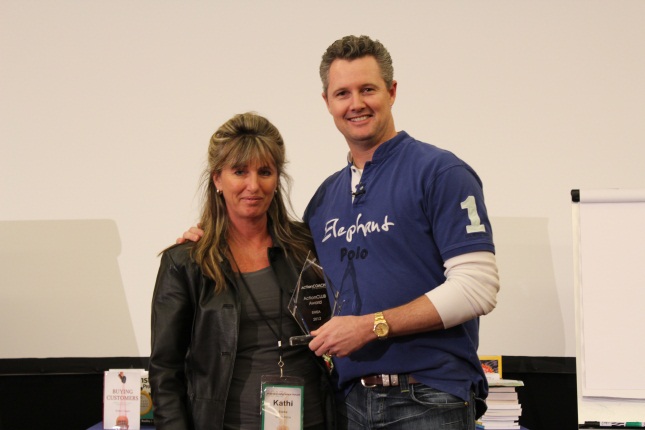
Cape Town’s very own business coach, Kathi Clarke owner of Building Best Business and an internationally-accredited ActionCOACH has made South Africa proud by being the only African representative to win an award at the prestigious annual Europe, Middle East and Africa (EMEA) Business Excellence Awards which recently took place in Portugal. Above, Kathi Clarke with Brad Sugars, Founder of ActionCOACH.
The Business Excellence Awards hosted annually by ActionCOACH – the world’s number one business coaching company - formed part of the three day Business Excellence Forum where business owners and international coaches from the EMEA region gathered to exchange valuable insights into building great businesses and share best practices. The awards were categorised in two key focus areas: Entrepreneurial Awards and Coaching Excellence Awards.
Clarke won one of nine Coaching awards in the Coaching Excellence category for her contribution to growing clients’ businesses through group coaching. The awards were judged according to business results and constitute one of the highest accolades in the ActionCOACH business coaching arena.
Clarke comments, “It was a huge surprise as a South African delegate in an international arena to be singled out for excellence. I’d gone there feeling blessed to be learning from great coaches to find myself unbelievably numbered among them. It was wonderful validation that coming from Africa we can hold our heads up high. It is also testimony to the on-going commitment of my entrepreneurial clients who have worked incredibly hard with me to achieve their business success and continue to do both themselves and our economy proud.”
Brad Sugars, the Founder of ActionCOACH, mentioned in a speech at the event that the awards were in recognition of Business Coaches and Entrepreneurs who are taking what they do from good to great. The other winners included:
Best ActionCLUB – group coaching – Kathi Clarke – South Africa
Best Coach - one-to-one – Peter Boolkah - Britain
Best ProfitCLUB – networking – Thierry Mouton – Ile de France
Best GrowthCLUB – quarterly planning – Jas Darar - Britain
Best MasterCoach – coaching coaches – Kevin Stansfield – Britain
Best Executive Coach – John Cottrell - Britain
Best Client Retention – Peter Boolkah – Britain
Best Client Results – Derek O’Dwyer - Ireland
Most Improved Coach – Colin Harding – Britain
Kathi Clarke is an Industrial Psychologist, international award winning and certified ActionCOACH Business Coach and a business growth expert. With over 25 years’ experience in growing businesses, she and her company Building Best Business since coming to South Africa in 2011, have successfully helped more than 50 entrepreneurs to significantly grow their profits; develop entrepreneurial muscle and enjoy the lifestyle which prompted them to start their own business in the first place. Kathi also finds the time to offer her services probono to NPOs.
For more information about Kathi and her services, contact her on kathiclarke@actioncoach.com
The role between academic interaction with social partners explored
What kind of responsibility does a university have to its surrounding community? How does interaction take place between universities with the society at large especially in South Africa? And who benefits from the relationship? These were some of the pertinent questions raised during a lively debate hosted by the Central University of Technology (CUT), Free State in Bloemfontein earlier this month as part of their public lecture series.
“When it comes to our relationship and working with the society or communities at large; we see our role and responsibility as moulding, mentoring and educating students that are competent, caring, responsible and productive; and are well prepared for the workplace to help build the economy of South Africa. Our social responsibility is to provide a platform for the development of social and technological innovations for the benefit of the society at large,” said Prof Thandwa Mthembu, Vice Chancellor and Principal of Central University of Technology, Free State.
“Therefore, our focus on community engagement should be to work closely with business and industry, government and community organisations to transfer our social and technological innovations that should, in turn, help solve our societal problems, not only for the benefit of this region, but also the rest of South Africa, Africa and beyond”.
“In teaching and learning, the mandate of a university of technology like ours is to produce graduates with high level intellectual and work-focused skills geared for the workplace. We therefore cannot operate in isolation from what the industry, business and government expect of our graduates.”
“Our competencies in applied research in areas such as additive manufacturing, advanced product manufacturing, agriculture, and food safety can help us to come up with innovative ways to secure a sustainable food supply for the benefit of the region and improve the manufacturing capacity of the central region. In order to achieve these solutions, we have to work closely with the manufacturing and agricultural industries “The relationship between our university and industry is critical to being innovative in knowledge transfer and, in turn, for the upliftment of our society at large,” concludes Mthembu.
For more information about CUT and the social responsibility projects that the university is involved with, visit www.cut.ac.za. CUT is also on Facebook and Twitter (@cutfsonline)
###
CUT closing the critical skills shortages gap
Bloemfontein - Central University of Technology, Free State (CUT) proudly conferred two doctorates in Electrical and Mechanical Engineering, as well as close to 300 graduates in the engineering field this week, thereby contributing and helping to work towards Government’s aim of developing 30 000 engineers by 2014.
“South Africa has for many years placed the field of engineering on the critical skills shortages list. We are very proud of our engineering students, who graduated this week and will be entering the workforce and contributing to the economy of South Africa,” said Dan Maritz, Director of Communications and Marketing at CUT.
“Both our doctoral candidates opted to study at CUT so that they could conduct their research using our world class infrastructure, which is exclusive to the Centre of Rapid Prototyping and Manufacturing (CRPM) at CUT. Rated the best of its kind in the Southern Hemisphere, the Centre allows academics and scientists to conduct applied research in a more conducive environment, supporting and advancing innovations.
“We are proud to have achieved this important milestone that sets the tone for the university to become such an important resource not only in the region, but to South Africa, Africa and beyond,” concludes Maritz.
For more information about CUT and it’s graduation program, visit www.cut.ac.za. CUT is also on Facebook and Twitter (@cutfsonline)
###
