

Mustadafin Foundation sets up Isibindi child care programme in Tafelsig
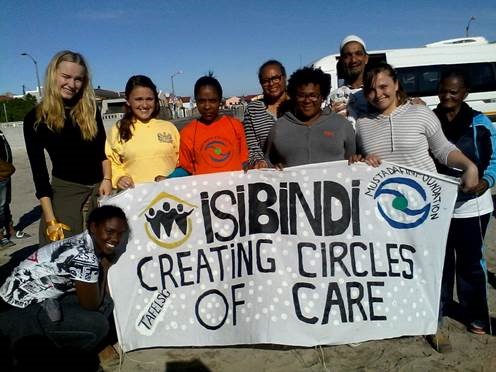
Mustadafin Foundation has launched the Isibindi child care programme in Tafelsig to protect vulnerable children. In a community where poverty, substance abuse, alcoholism, rape, teenage pregnancy and dropping out of school are the norm, the Mustadafin Foundation is creating safe circles of care for children at risk.
Isibindi, which means “courage” in Zulu, aptly describes the young vulnerable boys and girls that the programme seeks to assist. There are already over 150 children on the Isibindi programme which started a month ago in Tafelsig.
The National Association of Child Care Workers (NACCW) has, together with local organisations established almost 300 Isibindi projects across the country, serving over 100 000 children. The Isibindi model enables poorly resourced communities to develop effective protection services for children.
Members of the local community are recruited and trained to be care workers. They receive one week of training every month for two years and can continue to further their career in care work with the NQF level 4 qualification they receive at the end of the training. These care workers are carefully screened for suitability to work with children according to guidelines stipulated by the Department of Social Development. They are passionate and work tirelessly to look out for children’s best interests, well aware of the important role they play in the community and the lives they impact.
“There is a great need in this community and in the first month we have already come face to face with challenges which include child labour and sodomy,” says Morishia Fortuin, Health Coordinator at Mustadafin Foundation. “Every child deserves to grow up in a place where they feel safe and free. Isibindi carers provide this circle of safety for the most vulnerable children who are otherwise the first victims of various kinds of child abuse.”
Safe Parks, one of the initiatives of the programme, ensures that children in the community can play freely and in safety at parks and public recreational areas. This is particularly important over the school holidays when children are often left without adult supervision while their parents are at work. Some children with little access to nutritious food are now receiving food parcels as part of a feeding scheme.
“This project is not just about keeping children safe and giving them food. It goes much further than that, it provides a holistic approach to help each child develop to their full potential. The care workers are equipped with key skills and become that second set of eyes and ears to watch out for the children’s best interests,” concludes Fortuin.
For more information on Mustadafin Foundation, visit www.mustadafin.org.za. Join their Facebook page at www.facebook.com/MustadafinFoundation
Infrastructural transformations promoted for more equitable citizenship
Taking place at the chic and popular space The Sheds from 24 to 26 September 2015, AZA2015 will tackle the much debated topic of our cities’ future. With leading industry minds coming together, the event promises to challenge visionary thinkers in the architectural and design fraternities.
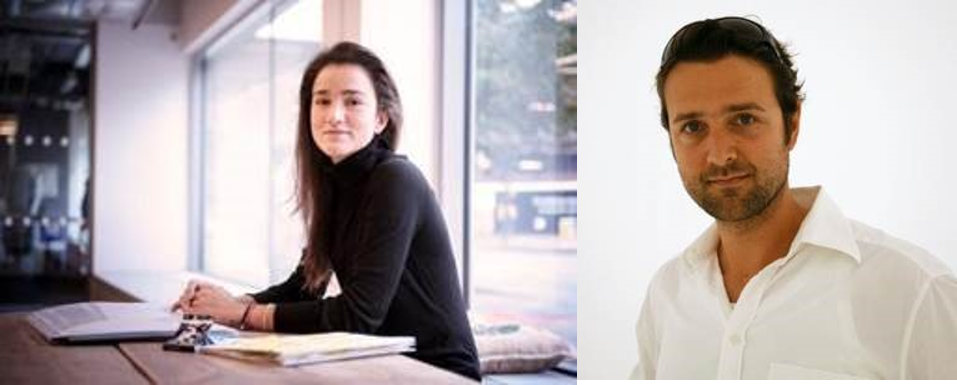
Julia King is an architectural designer focusing on sanitation and participatory processes in developing countries. She is currently working on the United Kingdom (UK’s) Economic and Social Research Council (ESRC) funded project ‘Super-diverse streets: Economies and spaces of urban migration’. The project explores the intersections between city streets, social diversity and economic adaptations in the context of accelerated urban migration in the UK. The research is a comparative analysis of ‘super-diverse’ high streets that aims to explore how urban retail economies and spaces are shaped by and shape migrant practices.
In addition, Steffen Lemmerzahl, co-founder of SLIK Architekten in Zürich will grapple with rule-based architectural design. He has been using and programming computers for more than 20 years and combined both worlds as the Chair for Computer Aided Architectural Design (CAAD) at ETH Zürich from 2004 to 2010, where he covered algorithm-based design methods and advanced use of 3D/Visualization techniques. Lemmerzahl will head the AZA2015 Parametric Design Masterclass alongside Enrico Daffoncio, which is taking place from 26 to 28 September 2015. The masterclass is an intensive, two and a half day programme and aimed at the design and construction of innovative pavilion prototypes.
Architects’ future and the ‘Futury City’
There has been a lot of focus on the need to create equitable, inclusive cities under the mantra of the ‘right to the city’. “This is an architectural project, I don't see this as a problem of rights - all citizens have right, it is the actualisation of the rights into practice which is missing,” says King.
Lemmerzahl adds that some experts speak of a big ‘void’ in the art world and that he envisions that architects and designers face a similar change of direction. “Here in Switzerland some architects get inspired by pre-modern designs, others try to be as pragmatic as possible within the traditions of modernity. Not one of them can inspire a whole generation of architects any more. It is likely that whatever the future will bring for design won't originate from Europe or America for the first time in centuries.”
Architects and designers’ role in advancing cities
Speaking about architect’s most important role, King elaborates, “Architects should play a critical role in building cities capable of engaging with the complexities of what we can call the ‘majority world’. This involves engaging within the reality of which everyday experiences are lived and created. As we see the erasure of social welfare and the simultaneous deployment of rapid, unchecked urbanisation we need to understand and operate within emerging formations of city making.”
Lemmerzahl adds to this that architects’ role right now is translating the mental state of society into spaces and argues that a shift needs to take place where industry should spend more time influencing the mental state of society through politics and cultural debates. “Right now, two different kinds of cities come to our attention. Firstly, shrinking cities where we need to find formulas on how to keep them liveable with hardly any budget available. In these cities architects can enable the residents to help themselves, mostly by sharing designs and ideas. On the other hand, booming cities are facing waves of gentrification that drive broad levels of the population out of town. Here architects should help to find ways to make affordable housing possible, even in the hippest districts,” shares Lemmerzahl.
The built environment as an indicator of economic, social and cultural changes
Lemmerzahl highlights that there are cultural changes that had very big impacts on design, for instance the modern movement of the early 20th century. He continues that we observe a democratisation of architecture as a result of social changes. “While architecture has been reserved mostly to the elites up to the beginning of the 20th century, the working class came into architects focus during the 20th century. Lots of great minds have spent their working life to realise high quality, low cost housing. Nowadays this extends to people who have no income at all. Several architects start to work in informal areas around the world, they even take care of the funding themselves, improving the lives of up to a billion people,” he continues.
“Our physical environment is the spatial manifestation of our economic and political priorities and policies. Redistribution is not going to happen, we've had 30 years of trying to get this right and the game is over,” says King. “Architects must begin to understand the architectural project as a social and political project beyond the building. Architects can and must play a role in divergent yet local civic projects.”
King concludes that a recent McKinsey report indicated that India will have to build between now and 2030, around 44 Mumbai's to deal with its urbanising population. “This is not necessarily a negative thing; rapid urbanisation is at the same time India's most pervasive challenge but also its greatest opportunity. I firmly believe in cities as engines of growth, opportunity, hope, and social change – but only if they are done well.”
AZA2015 is proudly hosted by the South African Institute of Architects (SAIA) and sponsored by PPC Ltd. Affiliated partners include: the Gauteng Institute for Architecture (Gifa) and the University of Johannesburg (UJ.) For more information about AZA2015, visit http://architectureza.org/. AZA2015 is also on Facebook (https://www.facebook.com/architectureza).
Tips for learners to tackle their homework head-on
The third school term is in full swing and what better way than to keep the momentum going by being productive and organised. Homework Life Skills Enrichment Programme (HELP), an afterschool programme assisting primary school learners with their homework, encourages children to tackle their homework head-on and make education a top priority this semester.
Anna-Marie Kaars-Sijpesteijn, co-founder of HELP says, “Although many learners view homework as a tedious activity, it is vital in building discipline and getting comfortable with the syllabus. Homework is not something learners should tackle half-heartedly as it’s the first stepping stone in reaching their dreams.”
HELP has been assisting primary school learners in the Vrygrond area of Cape Town with Maths, English and Afrikaans for the past six years. Here they share some easy steps to make the most out of homework time:
- 1. Set time aside for homework
Set a specific time aside every day for homework. Kaars-Sijpesteijn motivates, “Do your homework as soon as possible so that you know it’s done and you have the rest of the afternoon free. If you have extra-curricular activities, slot a time in your schedule after you have settled down.”
- 2. Allocate specific time slots for different subjects
”Check what homework you have before getting started and plan accordingly by allocating how much time you should spend on each subject. Even If you do not have any homework, revise the lessons you have done at school that day,” advises Kaars-Sijpesteijn.
When a test or exam is coming up, start preparing well in advance and allocate more time to revise all the lessons. Learning is not about repeating information parrot fashion; it is about acquiring more knowledge. To accomplish this you need to understand what you are learning.
- 3. Be comfortable at your working space
Be comfortable while doing homework by sitting upright. This will also help you to focus more. “Have some refreshments when you get back from school so that you are not distracted by food,” recommends Kaars-Sijpesteijn.
- 4. Learn to switch off from outside noise
It is not always possible for the rest of the family to keep quiet while you are learning. “One of the greatest skills you can master is to switch external noises off by focusing your full attention on the work you are doing,” urges Kaars-Sijpesteijn.
- 5. Break-time is important
Give yourself regular breaks. Concentration is at its best for about 45 minutes at a time. “Get up and do a few exercises every 45 minutes. This will stimulate the brain as your blood flow will increase, sending more oxygen throughout your body. Then settle down again and continue with what you were studying,” motivates Kaars-Sijpesteijn.
- 6. Find a study method that suits you
People learn in different ways so find out what is the most effective one for you. If you learn better by looking and hearing things, then find a YouTube video that explains it. If reading suits you better, try finding extra information on the internet but make sure that it is reliable information. Kaars-Sijpesteijn says that some children find it more effective to study with a friend and discuss the subject. If this study style motivates you, be sure that it is a friend who wants to study as much as you do so that you do not end up distracting each other.
- 7. Ask, ask and ask!
Remember to always double check what activity the teacher gave as homework and what they require from you. If you are uncertain, ask your teacher or a fellow school friend to be sure – there is no shame in asking!
“We want to encourage children that learning is fun! There is no greater joy than to see learners excel in their schoolwork and getting the confidence they need,” concludes Kaars-Sijpesteijn.
If you would like to support HELP either through funding or volunteering, please contact them on 073 271 7806. For more information on HELP, visit www.help-eduprogramme.co.za. Join their Facebook page at www.facebook.com/HELPeduprogramme.
Braam Malherbe and Scott Ramsay to judge children’s wildlife art competition
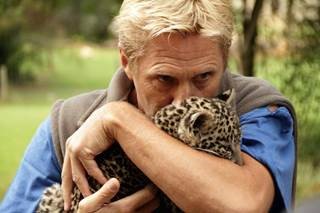
On 27 July 2015 a magnificent collection of children’s wildlife art will be judged at the Vineyard hotel by respected conservationist and business leader, Braam Malherbe, and conservation photojournalist and K-way ambassador Scott Ramsay.
This is the third annual wildlife art competition hosted by the Cape Leopard Trust (CLT). This year’s theme encompasses all predators of the Cape. The main objective of the competition is to educate learners to acknowledge the role that predators play in natural systems.
Of the many beautiful pieces of unique art, 12 will be selected to make up the 2016 Cape Leopard Trust calendar. The artworks will also be framed and displayed at the Trust’s annual fundraiser in August 2015. The young artists will each win a spot to attend an exciting a Cape Leopard Trust camp in the Cedarberg Mountains.
“I am honoured to be a judge alongside Scott in this fantastic initiative. Without educating our children about the vital role that animals play in our ecosystems, there will be little respect not only for animals but also for the importance and significance of ensuring wilderness areas remain pristine for generations to come. Our children are tomorrow’s leaders and unless we show them how intrinsically linked all of life is, we will continue on this dreaded path we have created for ourselves. We must show our children that greed and over-consumption of our natural resources will not only be the demise of so many species, but ours as well,” says Braam Malherbe.
Malherbe continues, “I am proud to be the official ambassador for the MySchool MyVillage MyPlanet fundraising programme who support the Cape Leopard Trust. When I was at the South Pole with the MyPlanet flag I said ‘if we do not have good education, how can we respect and look after our villages, and indeed, our planet?’ The Cape Leopard Trust not only protects our leopards but also takes children on wilderness camps in the magnificent Cederberg mountains. I cannot over-emphasise the importance of outdoor environmental education and the priceless value it can bring to a child, as a future leader and global citizen.”
“One of our Big Five, the rhino, is already in danger of extinction. Thanks to the MyPlanet Rhino Fund we are now raising over R200 000 per month for best practices in rhino conservation. Elephants and lions are also being threatened. What an indictment on humanity if we lose one or more of our Big Five! The role that organisations like the Cape Leopard Trust play in education and protection of species such as the leopard (also one of the Big Five) is to be applauded,” concludes Malherbe.
For more information about the Cape Leopard Trust, please visit www.capeleopard.org.za. For more information about Braam Malherbe, visit www.braammalherbe.com.
###
Architecture for the body, mind and soul

Caption: Johannesburg – are you ready for the most spectacular site specific dance performance? Nimrod Freed/Tami Dance Company will transport attendees at the ArchitectureZA 2015 (AZA2015) event to another world as they perform the world-renowned ‘PeepDance – the body is the last space for freedom’ (above) on 24 September 2015. AZA2015, proudly hosted by the South African Institute of Architects (SAIA), will take place at the trendy The Sheds in Johannesburg from 24 to 26 September 2015 – an urban culture and design festival not to be missed!
Themed ‘The body is the last space for freedom’, PeepDance is a new, unexpected and mind-blowing contemporary dance performance which will inspire and take your breath away. In a world where we are constantly being looked at, PeepDance is challenging freedom and the reality of culture by exploring perspectives and different ways of expression.
Talia Freed, Art Director and Designer at Nimrod Freed/Tami Dance Company explains, “Three to five dance pieces take place inside ‘peep’ cells, which are performed at the same time. The audience walks around these cells and ‘peep’s through the holes to experience contemporary dance at a whole new lens.”
The PeepDance performance compliments this year’s AZA theme of ‘Future City’ where elegant solutions will be discussed to address the challenges future cities face.
“In a society where technology and media have a tendency to invade our personal realities, it should not mean that we are being controlled. Private and public spaces are changing and it is how we look at these transformations that create our realities. PeepDance will highlight just that where every individual will have their own experience while being part of a collective audience,” says Daniel van der Merwe, Architect and Marketing at PPC and President at the Gauteng Institute for Architects (GIfA).
The Student Architecture Festival Committee has secured sponsorship from the generous local architecture fraternity to bring the Spanish director of the award-winning documentary, The Competition, to Johannesburg. The film will enjoy its African premiere at AZA2015 on 24 September 2015. Architect Angel Borrego Cubero’s film grapples with the inner workings of some of the world’s most prestigious architectural firms to present the best proposal for the National Museum of Art of Andorra. The film follows design giants Jean Nouvel, Frank Gehry, Dominique Perrault, Norman Foster and Zaha Hadid to win this prestigious competition. With an after-film Q&A with the director, Borrego Cubero, this is a must-see during AZA2015!
The architecture packed event will end off with riveting urban tours on Saturday, 26 September 2015. Delegates and the public can choose from the Open Spaces Walking Tour, Chinatown Walking Tour, Johannesburg Heritage Walking Tour, Soweto Apartheid Museum Concourt, Western Edge to Gandhi Square Tour or Liliesleaf Freedom Park.
AZA2015 is not just a conference; there will be master classes, workshops and multitude of public events. It is an opportunity for interested participants from non-design disciplines to share in the future of South Africa’s cities and be part of the regeneration of major urban life, right in the heart of Johannesburg.
AZA2015 is proudly hosted by the South African Institute of Architects (SAIA) and sponsored by PPC Ltd. Affiliated partners include: the Gauteng Institute for Architecture (GIfA) and the University of Johannesburg (UJ.) For more information about AZA2015 and to book, visit http://architectureza.org/. AZA2015 is also on Facebook (https://www.facebook.com/architectureza).
From till packer to ECD principal - one woman’s inspiring story
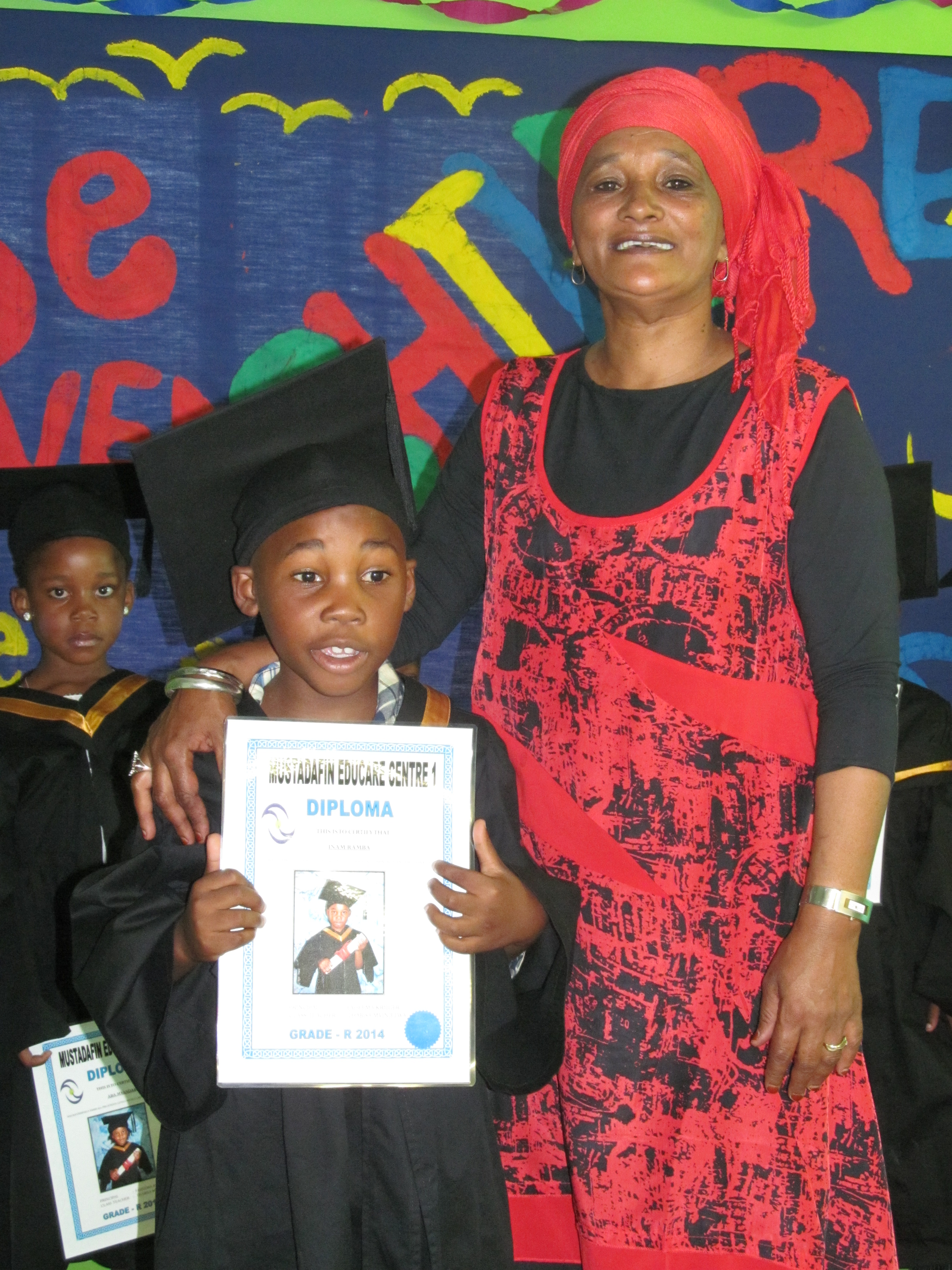
Caption: Despite a very difficult start to life, Fahiema Kruger (above picture, on the right) has an inspiring story to tell this Women’s Month, thanks to Western Cape non-profit organisation, Mustadafin Foundation. The Principal of the Foundation’s Early Childhood Development (ECD) Centre in Khayelitsha is a shining example of a woman who has overcome life’s hardship and turned it into a success.
Kruger was three years old when she and her brother were fostered. At the age of 13 her family were forced to relocate from District Six to Hanover Park. Four years later, while in Grade 10 at the age of 17 she fell pregnant and dropped out of school. Disgraced at her pregnant daughter, Kruger’s foster mother threw her out of the house. Kruger moved in with an aunt to provide for her new born baby. Although Kruger did not live at her foster parents anymore, her foster father was supportive of her and did not judge her circumstances. She started working as a till packer at the local supermarket and then became a cashier. At 20 Kruger got married and had three more children but her husband exploited her financially to fund his drug habit while subjecting her to constant verbal abuse and infidelity.
“At times I didn’t know what to do or where to go. I felt alone and angry with the world. There was a time when I believed the words my husband said to me were true. I kept asking myself, ‘What is wrong with you Fahiema? Why are you are always defensive and angry?’ My life was a hell,” recalls Kruger.
She was an emotional wreck and lost her spark and confidence which meant she could not care for her children who were also traumatised and angry.
“Women must know that they need not settle for abusive relationships, they are valuable and should be valued,” said Ghairunisa Johnstone, Mustadafin Foundation Director. “At Mustadafin Foundation we empower women with self-confidence so that they can say no to abuse, be it physical or emotional.”
After 25 years of an abusive marriage, Kruger divorced her husband. Her life turned around when she got involved with Mustadafin Foundation as a volunteer cook. Three years later she became a full time cook at the non-profit’s Delft Centre which provides hot meals for disadvantaged members of the community.
Despite her own financial struggles, Kruger felt at home within the Mustadafin community. There she participated in practical training workshops on parenting, beautification of womanhood, crowd control, fire prevention and First Aid. Kruger regained her confidence and saw potential for a bright future. She dreamt of doing more than just cooking food at the Foundation and started studying Education. Kruger moved to work at the Foundation’s Khayelitsha Centre where she met her current husband. “Mustadafin Foundation uplifted me when I was down from my first marriage and carried me through those years of struggling,” reflects Kruger. Last year she took on the new role as Principal of the Early Childhood Development Centre in Khayelitsha and also keeps herself busy with Level 5 Education Studies.
“Being the only non-Xhosa person in Khayelitsha made me feel out of place at first,” says Kruger, referring to the communication challenges she experienced when moving from Delft. However, Kruger recognises the privileged position she holds of living across two distinct cultures. “It is a gold mine for me because I have a lot of opportunities to inspire the people. I’m community oriented with people in Delft and now also in Khayelitsha, but I’m more stable here in Khayelitsha. I’m here to stay. This is my second home,” concludes a very happy Kruger.
“Fahiema is one woman with a rousing story. Her life was on a downward spiral when I met her in 2000 but it has literally turned around and is a shining example to others of what is possible. There are many more women who need the same support Fahiema received so that they can also tell their own stories,” concludes Johnstone.
For more information on Mustadafin Foundation, visit www.mustadafin.org.za. Join their Facebook page at www.facebook.com/MustadafinFoundation
African Capital cities sign declaration of intent focused on sustainability
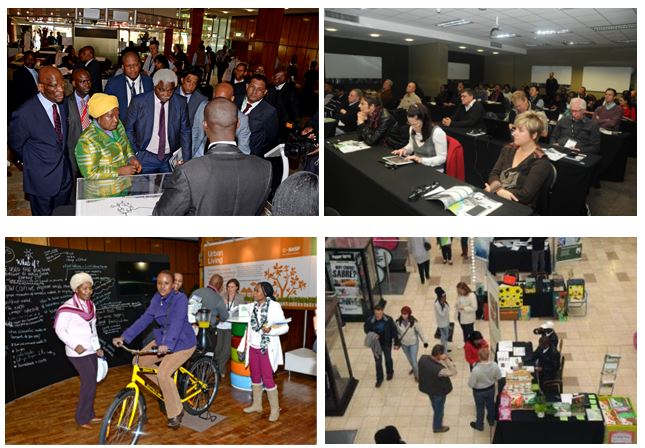
Caption: Ideas were formulated and set in motion at this year’s annual City of Tshwane Sustainability Week, which took place from 23 to 25 June 2015. The three day conference was hosted at the CSIR International Convention Centre. The inaugural African Capital Cities Sustainability Forum (top, left picture) opened the conference and set the tone for the eleven stimulating seminars. The Sustainable Infrastructure Seminar was one of three new seminars introduced in 2015 (top, right picture). Sustainability Week 2015 boasted 128 gripping speakers, 33 exhibition stands (bottom, left picture) and three networking events that added up to make this year’s event the most successful yet. The Green Home Fair at Brooklyn Mall ended the event in style on 27 and 28 July 2015 (bottom, right picture).
The African Capital Cities Sustainability Forum brought together 39 African capital city mayors and dignitaries from Angola, Benin, Comoros, DRC, Gabon, Gambia, Guinea, Lesotho, Malawi, Mauritanie, Mauritius, Namibia, Nigeria, São Tomé, Senegal, Somalia, South Sudan, Swaziland, Tanzania, Zambia and Zimbabwe. The mayors and dignitaries congregated to sign a declaration of intent that is the first of its kind on the continent. The declaration’s focus is to elevate the social, economic and environmental imperatives African cities need to adopt in order to develop society and the economy without adverse impacts on the environment.
Dr. Nkosazana Dlamini-Zuma, chairperson of the African Union Commission, emphasized that future cities must be authentic African cities focusing on the sustainability of the continent’s greatest resource, its people.
The mayors made a commitment to convene every year to assess progress and find collaborative ways to consolidate their vision for urban sustainability. These include green building methods; waste management; reduction of poverty; transport efficiency; technology; and making the best use of human resources to help facilitate the changes.
Jean-Pierre Elong Mbassi, the Secretary General of the United Cities and Local Governments in Africa, explained that the future of Africa depends on effectively managing integration and migration; sustainability and resilience; economic growth and job creation. Elong Mbassi emphasized that all of these contribute towards making Africa sustainable and self-sufficient. He added, “One of the daunting and demanding issues of global development is whether cities are an engine of growth, and whether this growth is sustainable and resilient.”
Mbassi also pointed out that, “Cities should resist the temptation to copy the unsustainable consumption pace of natural resources as other cities of the developed world”. As Africa is the continent with one of the youngest populations, the sustainability of its economic, social and environmental resources should be a pressing matter on the agenda of the continent’s leaders.
Sustainability Week highlighted that the core indicators of a country’s sustainable success are energy and water management, waste management and manufacturing ventures. Another indicator is identifying where partnership opportunities are that can ensure funding for projects that will benefit a wide variety of people. These issues were at the centre of the dynamic week of seminars, networking events and exhibition. The interactive exhibition space connected non-government organisations with local government representatives, product innovators and technical solution providers.
Following the three day conference, the Youth and Green Economy event took place on 27 June 2015 at Tshwane University of Technology (TUT). The Green Home Fair hosted from 27to 28 June 2015 at Brooklyn Mall marked the end of the eventful week. Lively discussions took place where 27 exhibitors offered the public a chance to be ‘green’ and environmentally conscious at home. Energy from the sun, home food gardening and general tips on becoming more energy efficient and resourceful at home made for practical engagement with residents.
Delegates had the opportunity to interact with colleagues and potential business connections. This promised for real time response between presenters and the audience enabling greater interaction on key topics such separation at source to reduce landfill, methods available to treat waste water and save water by better use of it in agriculture.
Green building architects and developers congregated to discuss innovation in building methods and responsible tourism was also on the agenda - a topic that is much on the minds of South Africans who are feeling the results of the recent drop in tourism.
“Communication is the key to helping all stakeholders understand what the sustainability issues are and where the solutions will come from. The conference’s aim of ‘putting ideas into motion’ has activated the new wave of thinking around sustainability from a city perspective. The event provided unprecedented opportunities to collaborate and find solutions as the city sets its goals to secure a sustainable development path,” said Gordon Brown, Director at alive2green, organiser of Sustainability Week.
This was the second year that alive2green and the CSIR International Convention Centre opened its doors to Sustainability Week (23 - 25 June 2015) hosted by the City of Tshwane. The conference was attended by 1474 delegates with foot traffic of over 2000 deleagtes over the three conference days, showing significant growth and interest in matters relating to the sustainable development of society.
Sustainability Week’s sponsors and partners include: City of Tshwane, BASF, Nedbank Group, Lafarge, Builders, NCPC, UNIDO, AECOM, NRF, Participate Technologies, Backsberg, REDISA, SANEDI, Tshwane University of Technology (TUT), Brooklyn Mall, The Star, Pretoria News, NRF SAASTA.
For more information on Sustainability Week and to review any of the presentations, visit www.sustainabilityweek.co.za. For information on next year’s Sustainability Week, please contact Gordon Brown at gordon.brown@alive2green.com. For City of Tshwane enquiries, please contact Dorah Nteo at DorahN@Tshwane.gov.za.
PRISA Powering ahead
Local businesswoman, Regine le Roux CPRP, managing director of Reputation Matters has taken over the helm of the Public Relations Institute of Southern Africa (PRISA) Western Cape branch as the regional Chairperson. Le Roux will also be representing the coastal regions on PRISA’s National Board of Directors.
The public relations (PR) industry has come a long way from where it was 58 years ago when PRISA was first established. “Professional bodies such as PRISA are important. It keeps practitioners in the communication field accountable for their actions, and at the end of the day it is about providing ethical communication support for our clients.”
“As with many other professional bodies, PRISA has its fair share of challenges. It is easy to complain about things from the side, that is why I decided to entrench myself within the structure to see how I can make a constructive contribution,” shares le Roux.
At the inauguration of the new President Loraine van Schalkwyk APR last week, van Schalkwyk reiterated that stakeholders in the communication profession need to become part of the solution to make things happen. Instead of being on the side-line bemoaning the state of affairs, they should get involved and help form the industry body into the professional organisation that you would like to be a part of.
Le Roux adds that many practitioners in the field feel that students have a wealth of academic expertise, but are not necessarily armed with practical skills needed on an operational level. “This year I challenge the communication and PR agencies in the Western Cape to actively become part of PRISA and provide mentorship opportunities to students so that they can learn. I also encourage students to get involved in PRISA and empower themselves by getting to know the industry. There are many wonderful opportunities for students to start networking and meeting key people within the industry and also for fellow communication experts to share knowledge, best practices and work towards taking PR and communication to the next level.”
For more information about PRISA Western Cape contact Regine le Roux or tel: 021 790 0208 / 083 302 1528 regine@reputationmatters.co.za
###
