
Sustainable designing for the future

Human civilisation’s destruction is inevitable especially with the onset of climate change and the simultaneous peaking of global oil supply; both of which have always been considered and discussed in isolation. The International Union of Architects (UIA) Sustainability by Design Conference that will be taking place from 29 - 30 November 2011 in Durban will be addressing these pertinent issues and discussing other factors which need to be taken into consideration when it comes to sustainable designs for the future.
Four different scenarios based on the interrelationship between climate change and the peaking global oil supply as put forward by David Holmgren, co-originator of the permaculture concept, will form the framework for the structure of the UIA Sustainability by Design Conference.
Each scenario presents an internally steady consistent and convincing look into the four futures that are highly credible and possible; each materialising very different kinds of energy mixes and strategies, including settlement form and patterns, mobility patterns, urban/rural and formal/informal dynamics, economics, governance, politics, culture and spirituality. The scenarios look at various intersections between benign to severe climate changes as well as slow to rapid energy decent.
In order to foster an all-encompassing debate, a workshop with a group of speakers drawn from various disciplines ranging from urban design, transportation, biodiversity, financing, sustainability, to African culture and philosophy will generate a truly multi-disciplinary approach.
The conference will primarily adopt participatory charrette and interactive formats, with speaker-panelists introducing their positions, problematic and points of perspectives in four-minute sound bites opposed to formal presentations, followed by professionally facilitated debates where the audience will be invited to interact with the process and the various points discussed
Lloyd Macfarlane, Director at alive2green says, “One of the intentions of the conference is to sketch the beginnings of the broad outlines of a built environment sector response to climate change that may serve to equip Conference of the Parties (COP) negotiators at next year’s COP18 in Seoul.”
For further information on the UIA Sustainability by Design Conference visit www.uiasustainabilitybydesign.org

What is in the air that we breathe?

Atmospheric pollution affects the quality of our air in many areas in South Africa, especially where there is industrial activity, such as coal burning power stations, and oil refineries. While this type of pollution more immediately impacts on human health, it is also a major contributing factor to the ‘greenhouse gas’ emissions which threaten to disrupt the fragile balance of our planet. The Institute of Waste Management of Southern Africa (IWMSA) urges both industry and individuals to pay more attention to combatting air pollution.
The IWMSA’s President, Stan Jewaskiewitz says “In the case of air pollution, we need to find ways of reducing our dependence on non-renewable fossil fuels and minimising the resultant carbon dioxide (CO2) emissions that are produced. It is critical that we create awareness of this serious issue.”
Large bodies of air cannot be contained, so the pollution thereof can only be controlled at source and we cannot retract harmful gases once they are released into the atmosphere. Globally, power generation alone is responsible for one quarter of the planet’s CO2 emissions, and there is no question that there is a much greater incidence of respiratory, as well as other diseases such as cancer, in areas close to fossil fuel-burning plants. The consequences extend even further; to both productivity and the economy.
Jewaskiewitz continues “The question of climate change is becoming more and more crucial, largely due to ever increasing volumes of CO2 being pumped into the atmosphere, and compounded by deforestation taking place around the world.
“It’s not only the industrial sector that is responsible for these emissions although they certainly produce the lion’s share. In less advantaged urban and rural areas where access to electricity is difficult or not affordable, and people depend on fires for heating and warmth, levels of smoke and other pollutants are unacceptably high. Often, on the African continent at large, mounds of waste are set alight, including hazardous materials: an extremely dangerous and harmful practice on many levels.
“We spend long hours commuting, and our cities and roads are often packed with vehicles belching forth toxic fumes due to non-compliance or inefficient operation. This remains a problem despite the fact that there are by-laws in place which aim to regulate emissions, especially from vehicles using diesel fuel. One study conducted in Los Angeles, a city renowned for its brown haze of smog, determined that up to half their residents' total exposure to harmful air pollutants occurs while people are traveling in their vehicles.”
Jewaskiewitz concludes “The IWMSA is proud to rank amongst its members, professionals in their fields, who voluntarily give of their time and expertise to further the cause of taking conscious action in all the arenas of waste management through continuous education and training. We hope to inspire people to think of innovative solutions to reducing waste at source, including that of air pollutants.”
The IWMSA is a professional, multi-disciplinary organisation with voluntary membership established to promote the science and practice of waste management and is a non-profit organisation. For more information visit: www.iwmsa.co.za or contact the IWMSA on 011 675 3462/4.
Waste in Business – Beyond compliance, towards opportunity

How should waste be managed by businesses; especially following the promulgation of the Integrated Waste Management By-law in 2009? Many businesses do not know what is expected from them or what to consider when it comes to managing the waste that is generated by their organisation.
Businesses are required to reconsider their current waste management practices and implement more sustainable solutions. To assist with this process, Alive2Green will be convening their successful ‘Waste in Business’ Seminar on 09 November 2011 at Emperor’s Palace, Ekurhuleni.
Lloyd Macfarlane, Alive2Green Director says, “The seminar has been structured in such a way to provide a platform for sharing and discussing information regarding the new legislation. Local businesses will be provided with information for them to make more informed waste management choices and to implement waste-aware practices.” Macfarlane continues, “Businesses will receive information so that they can understand what their responsibilities are in terms of the new Waste Act and the by-laws specifically pertaining to the City of Johannesburg, Tshwane and Ekurhuleni municipalities. The economic opportunities created by this legislation will also be under the spotlight.
“The Seminar also aims to consider the detrimental effects of current waste disposal technologies and the advancement of renewable and sustainable solutions” adds Macfarlane.
This Seminar will bring together some of the country’s leading business stakeholders who play key roles in initiating sustainable waste management and reduction projects, including manufacturers of products and technologies that will change the way we deal with waste in South Africa.
Waste Management experts will lead the discussions, Macfarlane says, “we are delighted at the high calibre of speakers that have been secured for the seminar who will be speaking on a wide spectrum of waste management issues within businesses. Government buy-in is critical for the success of these seminars, and we look forward to welcoming Mrs Edna Molewa, the Minister of Environmental Affairs and Tourism and Ms Makhosazana Baker, the Director of Waste Management and regulation for the City of Johannesburg as our key note speakers.”
Other experts in the waste management industry who will be presenting at the seminar include Rodney Reynders from Tetra Pack who manages all their environmental initiatives for the Sub-Sahara Africa region.
Lorraine Jenks, an activist and advocate of greener practices in hospitality operations and procurement and the founder of ‘Hotelstuff’ and the ‘Greenstuff’ link, will be focussing on Waste management challenges and solutions within the hospitality and tourism industry.
Executive Director of the Packaging Council of South Africa (PACSA) and Chairman of the Recovery Action Group (RAG), Andrew Marthinusen will be discussing the future of the paper and packaging industry supply chain waste hierarchy and Angus Ryan will lead the discussion about ‘Greening the Office’.
“Apart from these speakers who will be discussing pertinent waste management topics, we will also have leading businesses that have integrated waste minimisation into their company ethos, who will be presenting case studies in the form of break-out sessions which will allow delegates to interact and to learn from others’ experiences”, Macfarlane adds.
An exhibition of the latest waste related products and services will be incorporated into the seminar. Networking sessions have also been scheduled to give delegates an opportunity to share ideas.
For more information on the Waste in Business Seminar, please visit: www.alive2green.com/content/waste-revolution/conferences.html or contact Cara-Dee Carlstein, 021 447 4733 or e-mail - ccarlstein@alive2green.com
Accredited waste management training empowers employees and aims to improve service delivery

The Institute of Waste Management of Southern Africa (IWMSA), in collaboration with Interwaste, is proud to announce the launch of accredited training courses in the field of waste management.
Skills development is essential for effective waste management. Training enhances organisations’ ability to deliver a better service; empowering employees with the knowledge and ability to take control of their waste. Trained staff can only make effective decisions and action if they are properly equipped to do so and have a clear understanding of their business operations. In addition, training courses which have been accredited by the Local Government Sector Education and Training Authority (LG SETA) empower those who complete them by adding to a tally of credits earned towards a recognised equivalent qualification.
Stan Jewaskiewitz, President of the IWMSA, says “Recently, the IWMSA called for interested parties to share their accredited material with us, and after careful evaluation of the proposals received, we are delighted to have entered into a partnership with Interwaste. The IWMSA, in partnership with Interwaste, will now offer accredited training to groups of a minimum of 20 individuals per session, and we welcome any enquiries in this regard.”
Various unit standards are available within the National Qualifications Framework (NQF) levels one to four, and suitably qualified members of the IWMSA have been encouraged to register with the LG SETA as accredited assessors and moderators. The IWMSA will co-ordinate the training programmes from their Head Office using a national database of properly accredited facilitators.
Interwaste’s Group Human Resources Director, Rajas Pillay adds, “Interwaste is proud to be affiliated to the IWMSA in offering an accredited training programme, and we anticipate positive outcomes for the waste management industry through this collaboration.”
The IWMSA will also continue to run non-accredited waste management training programmes that cover the broader aspects of waste management. Jewaskiewitz notes, “This highly effective basic training has been well received by both private organisations and governmental agencies alike, and continues to grow in popularity as a much needed and credible educational tool.”
The subjects covered by the non-accredited Basic Waste Management training progamme include topics such as a basic introduction of waste management definition; integrated planning of waste operations and systems; collection transfer and transport of waste; waste minimisation, treatment and disposal of waste as well as the evaluation and implementation of service delivery.
For more information on the accredited and non-accredited training provided by the IWMSA, or to request a quotation, contact Gail Smit on (011) 675 3464, email iwmsa@telkomsa.net or visit www.iwmsa.co.za.
The IWMSA is a professional, multi disciplinary organisation with voluntary membership established to promote the science and practice of waste management and is a non-profit organisation. For more information contact the IWMSA visit: www.iwmsa.co.za
e-Waste Collection Drive to take place in Gauteng in November
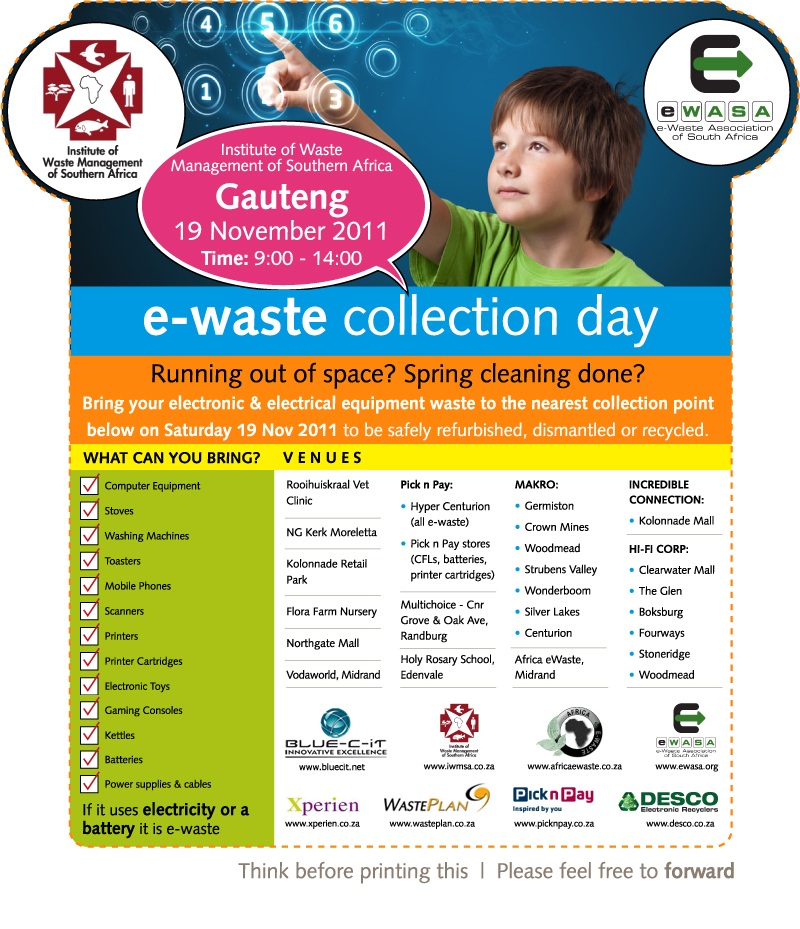
The IWMSA (Institute of Waste Management of Southern Africa) in association with eWASA (the e-Waste Association of South Africa) will be hosting an e-Waste collection drive in Gauteng on Saturday 19 November 2011 from 09:00 to 14:00.
The aim of the drive is to encourage people and businesses to bring all their electronic and electrical equipment waste (e-Waste) to the nearest collection point to be safely refurbished, dismantled or recycled. There will be in excess of 24 collection points across Gauteng accepting e-Waste on this day.
"e-Waste can be defined as anything that uses electricity or a battery and is no longer needed. This includes unwanted equipment such as computers, printers, fax machines, cell phones, toasters, microwave ovens, cabling, ink and toner cartridges, or any other electrical or electronic goods or direct parts thereof. Everything in the home or at the workplace that is driven by electricity, including battery operated items, falls into this category", explains Lene Ecroignard, Research and Development expert at eWASA.
"People often hold onto e-Waste, even if they are no longer using it, because it has a perceived value," says Jonathan Shamrock, Vice-chairperson of the Central Branch of the IWMSA. "But these items are merely creating clutter and could be put to far better use if refurbished or recycled. For this reason we felt it was pertinent to launch our e-Waste collection drive so that people can be informed about what e-Waste is and how to dispose of it correctly. e-Waste should by no means be discarded with your usual rubbish and should always be taken to a verified e-Waste disposal point," Shamrock explains.
e-Waste drop-off points on 19 November will be Africa e-Waste offices in Midrand; Flora Farm Nursery; Vodaworld; Hartebees Mall; Hi-Fi Corporation Boksburg, Clearwater, Fourways, Stoneridge, The Glen and Woodmead; Holy Rosary School; Incredible Connection Kolonnade Mall; Kolonnade Retail Park; Makro Centurion, Crown Mines, Germiston, Silver Lakes, Struben's Valley, Wonderboom and Woodmead; Multichoice offices in Randburg; NG Kerk Moreletta; All Pick n Pay franchise stores (for CFLs, batteries and printer cartridges only); Pick n Pay Hyper Centurion and Rooihuiskraal Veterinary Clinic. "As a result of the ever-increasing desire for newer, smaller, and faster technology, waste electrical and electronic equipment is now one of the fastest growing waste streams in the world.
Toxic or hazardous substances in electronic waste are typically heavy metals such as lead, mercury and cadmium, amongst others. Electronics also contain small amounts of gold, silver, copper, platinum; all precious metals that are in finite supply, along with plastic, lead containing monitor glass and other metals. Apart from being essential to keep as much hazardous waste as possible out of landfills, reuse of materials reduces the need to deplete precious resources," says Keith Anderson, Chairman of eWASA.
The IWMSA and eWASA hope to host many more such e-Waste collection drives in Gauteng in the future to continue building awareness and consumer consciousness around the management of e-Waste.
---
For more information on the e-Waste drive and for e-Waste disposal points in your area go to www.ewasa.org orwww.mywaste.co.za or contact the eWASA office by email at info@ewasa.org or telephonically on 031 575 8119.
---
The IWMSA is a professional, multi-disciplinary organisation with voluntary membership established to promote the science and practice of waste management and is a non-profit organisation. For more information contact the IWMSA on 011 675 3462 or visit www.iwmsa.co.za
The Department of Energy commits to ensuring that sustainable and affordable energy becomes universally accessible
The second annual Sustainable Energy Seminar has drawn to an end, with the full support from the Department of Energy who have committed to ensuring that sustainable and affordable energy becomes universally accessible.
Global leading researchers, sector leaders, government representatives and stakeholders of the energy sector all descended on Emperor’s Palace earlier this month and engaged and discussed pivotal energy related issues.
The keynote speaker was Ms Nelisiwe Magubane, Director General of the Department of Energy, South Africa. Magubane focused on the premise that, “the energy sector contributes significantly to adverse climate change and that this calls for countries, including our own, to re-look the energy mix going forward.
“Our energy sector accounts for approximately 60 percent of greenhouse gas emissions; it is therefore imperative to introduce practices that will reduce the demand for energy as a matter of urgency”.
Magubane commented on the White Paper that was promulgated by Government in 1998 and stated, “this paper envisioned an electricity industry that would increase the opportunity to exploit cheaper and environmentally benign generation options; has the potential for downward pressure on electricity prices and has the potential to improve energy security”. Magubane also shared her belief that the Department of Energy, in line with the vision of the White Paper, presides over a sector with arguably one of the highest potentials to improve the lives of the people of South Africa.
As a result, Magubane emphasised that the Department of Energy is committed to ensuring that sustainable and affordable energy becomes universally accessible.
Magubane also explained what the Government was doing to move nearer to this onerous goal and commented on the Integrated Resource Plan (IRP 2010-2030) that was approved by cabinet in March 2010. This defined a tangible plan for embarking on a low carbon energy future that also secures the participation of Independent Power Producers (IPP). Magubane noted that, “solar and wind generation constitutes over 16,000 megawatts of the portfolio up to 2030” and added that there has been an overwhelming response from IPP project developers.
The Sustainable Energy Seminar is seen as a build-up event to the United Nations Climate Change Conference (UNFCCC) COP 17, due to be held in Durban from 28 November to 9 December 2011.
Magubane commented on the importance of this conference as this is where the envisioned financial support of the international community will be discussed, and stressed that “as South Africa interacts with the world during this conference, it should be clear what we are doing on the ground, as actions speak louder than words.”
The Sustainable Energy seminar was attended by several other speakers and there were just over 40 participating organisations and exhibitors at the event, including Brand South Africa Partnership, Department of Energy, Department of Science and Technology, AVIS, Wesgro and Aurecon.
Lloyd Macfarlane, CEO of Alive2green, the main co-ordinators of the event, commented that, “the media plays a critical role in advancing sustainability and facilitating a move away from unsustainable practices by exposing what is bad and providing people with facts, information and knowledge about what is good. Alive2green strives to achieve this knowledge transfer in the energy sector and The Sustainable Energy Seminars are one of the many media platforms it uses”.
For more information visit:
Economic opportunities exist in green business and buying local
“Many economic opportunities exist for South African businesses in the field of climate change," said Dr Timothy Fasheun, Manager for the KwaZulu Natal Department of Agriculture and Environmental Affairs, at a business forum co-hosted by Proudly South African, the Responsible Packaging Management Association of Southern Africa (RPMASA) and Enterprise Ilembe in Ballito recently. “A scenario analysis conducted in Australia and New Zealand has shown that opportunities in climate change business could be worth millions of Rands per annum and could deliver greenhouse gas (GHG) savings of millions of tonnes of CO2 annually. It makes good business sense to understand and work to manage GHG emissions and to identify business opportunities that are likely to arise out of a carbon constrained economy,” Fasheun explained.
The same applies to businesses sourcing or supplying goods and services locally,” said Dalene du Preez, Executive Marketing and Communications Manager of Proudly South African. “Operating and buying locally not only reduces your carbon footprint but by supporting local business you are supporting the community in which you are based and as such helping to grow the economy of this country. From the end of this year it will become mandatory for Government departments to procure goods and services locally and this will create significant opportunities for South African businesses and stimulate job creation,” du Preez continued. One of the challenges that South African businesses seem to face is finding or recognising these opportunities in order to be able to tap into them. Both Proudly South African and Enterprise Ilembe have databases of companies providing locally manufactured goods and services and are also able to provide information on grants available from the dti (Department of Trade and Industry) to those wishing to grow and develop businesses locally. Government funding trough the National Treasury is also available via the Jobs Fund www.jobsfund.org.za.
An opportunity for local business that is about to land on our doorstep is COP17, the 17th United Nations Framework Convention on Climate Change, which will be held in Durban from 28 November to 09 December 2011. The COP (Conference of the Parties) adopts decisions and resolutions relating to International progress in dealing with climate change and successive decisions taken by the COP make up a detailed set of rules for practical and effective implementation.
“COP17 is an enormous undertaking for our province and our country,” said Liz Anderson, President of the RPMASA. “Whilst hosting the conference will provide opportunities for local businesses to benefit from the temporary influx of visitors to our country, the resulting decisions and regulations that come out of the conference will have an ongoing effect on how we conduct green business in South Africa,” Anderson continued. With increasing emphasis on the sustainable use of resources to reduce carbon footprint and GHG emissions, packaging has been recognised as both a problem and an opportunity. The RPMASA encourages businesses to reuse and recycle packaging wherever possible and has seen that business opportunities exist in the recycling and reprocessing of plastic packaging. Chemical and Industrial drums can be recovered to reprocess for re-use or recycled at end of life into other products with large resource, energy and emission savings. An estimated 1.25 million tons of plastic is converted annually, of which only approximately 45% is recovered for re-use. This figure could be significantly higher if more plastic packaging was recovered from the waste stream and processed for recycling.
RPMASA together with eThekwini Health have launched The Happy Drum Project, an initiative that provides thousands of community members in the Metro and KwaZulu Natal region access to clean plastic drums for transporting drinking water. The purpose of the project is to stop the sale of used chemical and industrial drums and containers which pose serious health and pollution risks to the public. The sale of the drums, which are locally manufactured, not only boosts the local economy but also facilities an environment whereby chemical and industrial drums can be reprocessed and recycled appropriately.
For more information about the RPMASA visit their website at www.rpmasa.org.za or contact Liz Anderson or Celenia Padayachee on 032 947 1145.
The RPMASA promotes the safe, efficient and environmentally responsible manufacture, fill, use, collection, transport, reprocessing, remanufacturing, recycling, reuse and final disposal of reusable industrial packaging.
Oils and Solvents: Invisible and Hazardous Goundwater Contaminants
Around two thirds of South Africa’s surface area is heavily dependent upon its groundwater. Pulled underground by gravity and stored in mainly non-porous rock cavities, groundwater is a valuable resource, especially in times of drought. The Institute of Waste Management of Southern Africa (IWMSA)’s, Western Cape branch hosted a workshop last week to address the issue of Oils and Solvents as hazardous waste, and the correct manner in which to store and dispose of these two substances, which could otherwise cause irreversible damage to our precious groundwater.
Oils and solvents are required to be properly contained, marked and stored before being disposed of; with the correct permits in place, and at suitable hazardous waste management facilities. Melani Traut, IWMSA committee member and Professional Scientist says “Whilst commercial entities are largely responsible for producing waste oils and solvents, the public also needs to be informed of the dangers of irresponsibly dumping such materials. One shocking statistic is that the oil, from one oil- change on a single motor vehicle, can potentially contaminate up to 3 million litres of ground water. That’s more than an Olympic sized swimming pool (which holds 2.5 million litres of water).”
We all know the effects on fish and birdlife when there’s a major oil spill on a body of water. The oil spreads out into a thin ‘monolayer’ which acts as a barrier, depleting anything beneath it of oxygen. Although not visibly obvious, a similar situation occurs when oil or any other harmful liquid infiltrates soil. It impacts on groundwater, affects permeation by covering roots, interferes with osmosis and can literally poison plants and animals, not to mention humans.
Solvents are another cause for concern and produce unseen toxic gases which are volatile and flammable. Sometimes, the mere vapour from solvent residues is enough to explode or ignite with the slightest spark. If some proprietary/specially designed emulsified solvents are disposed of incorrectly, they will pollute and upset the pH balance of the landfill site and increase the salinity of the leachate (leachate is similar to the liquid that collects in the bottom of waste bins), since they may contain caustic soda and other salts. All liquids sink right to the bottom of landfills and if the landfill is not designed to carry hazardous waste, they can damage the landfill liner, escape into the earth, and hence into the groundwater.
Liquid groundwater pollutants are both mobile and insidious, which makes them extremely difficult to contain. It is, however, encouraging that there is a plan in place in South Africa, where over the next five years all liquid waste will eventually be banned from landfill. In the meantime, it is essential to prevent such hazardous waste from entering the environment illegally.
Hamied Mazema, IWMSA committee member and Professional Chemical Process Engineer says “We have to alter our thinking. If you design something, you have to consider the end result. Simply put, we need to avoid producing the hazardous waste to begin with, in order to prevent having to dispose of it; reuse materials, recycle diligently and recover whatever we can. Disposal should be the last port of call.”
The IWMSA provides education and training for its members, offering opportunities to network and exchange information with like-minded individuals, and to have a voice in the formulation of legislation.
The IWMSA is a professional, multi-disciplinary organisation with voluntary membership established to promote the science and practice of waste management and is a non-profit organisation. For more information visit: www.iwmsa.co.za or contact the IWMSA on 011 675 3462/4.
Etafeni's Green Fingers Grow Goodness
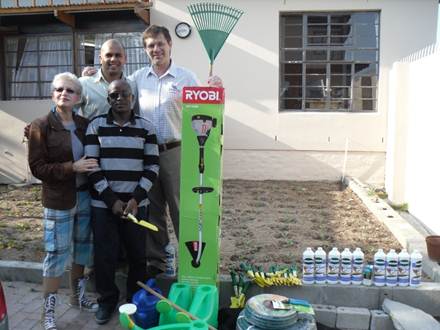
Western Cape - Etafeni Day Care Centre is now able to continue to provide fresh, organically grown vegetables for up to 200 healthy meals daily at their centres in Nyanga and Vrygrond, due to the generous donation of gardening equipment, seedlings and compost by the Institute of Waste Management of Southern Africa (IWMSA).
In addition to the food gardens at each centre, the Etafeni staff have also established 20 community food gardens at their clients homes in the past two years. The Etafeni Day Care Trust, in partnership with the local community, has built multi-purpose day care centres which take into account the needs of vulnerable children, the needs of those who care for them and the needs of the community. Etafeni views the physical structures and services on their sites as a metaphor for what they hope to see happening inside all the role players: the gradual growth of trust, of softness, of creativity and of enjoyment of self and others.
The Western Cape branch of the IWMSA identified and selected Etafeni as a beneficiary for their annual community outreach initiative based upon Etafeni’s commitment to developing food gardens and their best-practice model of sustainable community-based care for AIDS-vulnerable children and their caregivers. The IWMSA thanks Builders Express who offered free delivery, as well as a substantial discount on the items that were purchased.
Photo caption: Barbara Miller (Etafeni Day Care Centre, Development Manager) left, Mahier Abrahams (IWMSA Western Cape Branch, Committee Member) centre back, Mzoxolo Menyo (Etafeni Day Care Centre, Equipment Manager) front, and Richard Emery (IWMSA Western Cape Branch, Chairman) right
Caution is crucial when disposing of CFL's
Have you ever wondered what to do with your old Compact Fluorescent Lamps (CFL’s) The Institute of Waste Management of Southern Africa (IWMSA) encourages all South Africans to make use of proper disposal facilities to dispose of CFL’s as they contain small quantities of mercury as vapour inside the glass tubing and are therefore classified as hazardous waste.
The use of CFL’s as opposed to incandescent light bulbs is very much on the increase, especially as we all attempt to conserve energy and minimise our electricity bills. Stan Jewaskiewitz, President of IWMSA says “Along with this fairly new and more energy efficient product, comes a new set of waste management challenges.” He continues, “The IWMSA supports the City of Cape Town’s initiative to create an awareness of the proper disposal of CFLs. The City wants people to be aware that CFL’s contain small amounts of mercury, which is poisonous, and as such should not be thrown away with one’s regular domestic waste, NOR should they be included in recycling bins or bags. Thoughtlessly throwing CFL’s out with everyday garbage poses a serious hazardous waste problem at landfills and waste incinerators, where the mercury from these lamps could be released if they are broken, resulting in air and water pollution.”
Where can you take your used CFL’s? Fortunately many citizens have easy access to drop-off points at their local PicknPay and Woolworths retail outlets, where specifically marked bins are situated for this purpose. CFL’s need to be kept separate from other refuse, safely stored, preferably in their original packaging, and correctly disposed of at a drop-off/collection point or approved hazardous waste facility. It is VERY IMPORTANT not to break or damage CFL’s at all. As an indication of how careful one should be, in the recycling process, CFL’s need to be crushed in an especially designed machine that uses negative pressure ventilation and a mercury-absorbing filter to contain mercury vapor.
Another everyday item to remember is the household battery which is also accepted by PicknPay in the same manner – a marked bin from where they are collected for safe disposal and recycling. Batteries should most certainly not be thrown out with your domestic refuse since they contain equally hazardous elements. It is essential that everyone takes responsibility for disposing of these relatively small domestic items in the proper way.
In the event of breakage of a CFL, special care must be taken to clean up and contain mercury and glass shards after which they should be contained in a plastic bag for correct disposal. If transporting a quantity of these lamps, as with any other hazardous waste materials, please contact an approved hazardous waste management company for advice.
Eskom has developed a comprehensive brochure regarding CFL’s, including correct disposal and advice on cleaning up broken fluorescent lamps. This brochure can be downloaded from their website or viewed via the IWMSA’s website, www.iwmsa.co.za.
The IWMSA provides education and training for its members, you can network and exchange information with like-minded individuals, and even have your voice heard in the formulation of legislation.
The IWMSA is a professional, multi-disciplinary organisation with voluntary membership established to promote the science and practice of waste management and is a non-profit organisation. For more information, contact the IWMSA visit: www.iwmsa.co.za
