

Your reputation and AI
I will admit it; I use Artificial Intelligence (AI) regularly. I used to be very wary of AI. Now, I jokingly and affectionately refer to it as my “bestie”.
AI has become part of my daily workflow. It helps brainstorm ideas, structure thinking, refine wording, summarise information, and yes, save time. In many ways, it is an extraordinary tool.
But there is a growing problem.
It’s not AI itself. The problem is uncritical, lazy, copy-paste use without human input, refinement, or ownership. People are not making the communication their own. Earlier this week, I encountered a situation where it was very clear that a candidate applying for a position had relied heavily on AI to generate answers in their application form, removing any real sense of personality, independent thinking, or authenticity, all things that matter when recruiting the right person.
I also see it far too often in business correspondence where the communication feels generic, repetitive, and strangely disconnected from the person behind it.
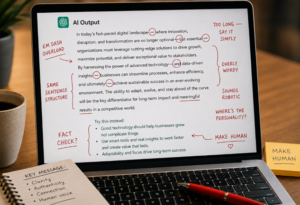
You can often spot AI-generated content almost immediately through the perfect structure, unnecessarily long explanations, and neutral personality.
Here are five dead giveaways that AI did the writing, not you.
- Em dashes. These are those long punctuation marks that suddenly started appearing everywhere. Once you notice them, you cannot unsee them.
The problem is not the punctuation itself. The problem is what it represents. Communication that feels manufactured rather than human. People may not always say, “This was written by AI,” but they often feel it.
In reputation management, the human element matters more than people realise.
Reputation is built through trust, consistency, authenticity, and relationships. When communication starts sounding generic, overly scripted, or emotionally disconnected, audiences notice.
- Everything becomes too wordy
AI loves words. Lots of them.
Simple thoughts become long explanations filled with unnecessary context and filler. Something that could have been said in a single line becomes three paragraphs long.
In business communication, clarity builds credibility. Sometimes shorter really is smarter.
- Your personality disappears
One of AI’s biggest risks is that it smooths out individuality.
Everything starts sounding safe, neutral, polished, and oddly similar.
People connect with personality. They connect with humour, honesty, quirks, and human imperfection.
That is what builds relationships and ultimately a solid reputation.
- Repetition creeps in
AI often repeats the same point several times using slightly different wording.
Once you notice it, you start seeing it everywhere.
In fact, trying too hard to sound professional can have the opposite effect.
- It sounds confident, even when it is wrong
This one is particularly dangerous.
AI can present inaccurate information with enormous confidence. It does not always distinguish clearly between fact, assumption, and interpretation.
AI should support expertise, not replace judgment. You have to fact-check everything.
The human layer still matters
AI helped write this article, but I still had to write, think, tweak, and polish. Bestie just made the process smoother.
I certainly didn’t accept the first draft we worked on. There were multiple iterations to make sure it still sounded like me.
It is important that you challenge it, shape it, refine it, and, importantly, know when to stop editing. There comes a point where too much polishing removes personality rather than improves clarity, and boy, can it take you down a never-ending path of micro-edits if you let it.
As much as AI is a marvellous tool, trust, relationships, emotional intelligence and judgment are what ultimately build your reputation.
###

The Sustainability of Trust

The Sustainability of Trust
Living Your Values When It Matters Most
Sustainable businesses are built on trust. Trust, in turn, is built on behaviour.
We all write beautiful words about who we are. Transparent. Ethical. Inclusive. Values-driven. Yet the real test of values is rarely found on a website or a paragraph in an annual report. It is found in the small, often uncomfortable moments of decision-making, when no one is watching, and only you have to live with the consequences.
Recently, I was reminded how easily words and values can drift apart. It was not dramatic, but it was enough to make me pause and reflect. In measuring and managing reputations, alignment is everything. When what is said does not match what is done, the gap becomes visible. Not always immediately, but inevitably.
Values in print are easy. They live on websites, in strategy decks and annual reports. They sound impressive. They reassure stakeholders. They position brands.
Values in practice are harder. They surface when communication becomes inconvenient, when expectations evolve. When acknowledgement is due. When clarity would be braver than silence. When honesty costs something.
Values need to be lived to come to life; otherwise, they are just words on paper.
Integrity is rarely tested in headline moments. More often, it is tested in subtle inconsistencies. The slight over promise. The shifting narrative depending on the audience. The omission that feels harmless in the moment. A small untruth is still an untruth, even when it feels commercially convenient. Sooner or later, behaviour exposes what language attempts to conceal.
Reputation is built in alignment with values. When behaviour matches stated values, trust compounds. When there is misalignment, stakeholders feel it, even if they cannot immediately articulate it.
Stakeholders do not score us on what we claim. They score us on consistency. Consistent behaviour builds trust. Reputation is the perception of that consistency over time.
For me, this reflection returned to one word: respect. Respect for the journey. Respect for those who contributed along the way. Respect for transparent communication, especially when relationships shift or opportunities change direction. It’s about acknowledgements that cost nothing but mean everything.
Living your values does not mean you never change your mind. It does not mean you never pivot. Business evolves. Partnerships evolve. Relationships evolve. What matters is how you manage that evolution, through direct, honest communication. Ultimately, reputation management is about fostering and sustaining relationships over time.
Values guide how we work, how we measure, and how we build reputation over time. They also guide who we work with. Values are a two-way street.
Alignment will not always be comfortable. It may cost opportunities. It may require difficult conversations. Yet over time, it builds something far more valuable than short-term advantage.
Once trust is eroded, rebuilding it requires far more effort than protecting it in the first place. Even then, a residue of doubt can remain.
Reputation remembers patterns of behaviour. Patterns are difficult to disguise.
Consistency, over time, becomes legacy.
###
When Whistleblowing Becomes a Weapon: The Hidden Reputation Risk Organisations Are Overlooking
Whistleblowing exists for a reason. In a country where fraud and corruption have seeped into too many corners of society, we rely on people with courage and conscience to speak up. Genuine whistleblowing protects organisations, prevents misconduct and strengthens accountability. It remains one of the most important mechanisms we have for ethical practice. The safety of whistleblowers is equally crucial. Without trust in the system, wrongdoing thrives in silence.
The term “whistleblowing” is, however, being used too loosely. It has become a convenient label for any form of dissatisfaction, conflict or unhappiness in the workplace. Yet whistleblowing has a particular purpose. It is not meant for ordinary workplace grievances or personal disagreements, but for reporting serious wrongdoing. It exists to uphold ethical standards, which fosters trust and confidence in your organisation.
From conversations with leaders across sectors and with individuals who have reached out privately, a troubling trend is becoming clear. Disgruntled employees are increasingly using whistleblowing channels to settle personal scores rather than report real misconduct. For example, false claims about financial misappropriation, favouritism or other forms of organisational misconduct can spread quickly and cause significant reputational harm.
Instead of serving the public interest, these false allegations aim to destabilise an organisation or tarnish the reputation of specific individuals. The moment an allegation is made, the organisation must respond. Time, money and attention are redirected from core work to investigate claims. Even when allegations are proven false, the reputational damage often lingers long after the truth emerges.
Irresponsible whistleblowing wastes resources, disrupts teams, damages morale and erodes trust.
This is where governance plays a vital role. Organisations with strong governance structures, transparent decision-making, and clear ethical standards are much better able to withstand false or malicious accusations that could harm their reputation. When your processes are solid and your records are transparent, you create a solid foundation that protects your reputation, even if your organisation is unfairly targeted. Transparency is not just good practice; it is a safeguard for your reputation.
False whistleblowing becomes far less effective in a system that is open, accountable and ethically consistent. In such environments, the truth tends to surface quickly. Stakeholders can see the difference between genuine misconduct and a manufactured crisis. Solid governance serves as both a shield and a compass. It protects the organisation and guides stakeholders toward informed judgment rather than reactive suspicion. When ethical foundations are strong, false claims struggle to stand.
Misuse of whistleblowing not only damages organisations, but it also undermines the very mechanism intended to protect them. Every baseless accusation makes it harder for a genuine whistleblower to be heard. In a society that desperately needs ethical voices to come forward, we cannot afford systems weakened from within.
Whistleblowing remains essential and must be used responsibly. When whistleblowing is misused, the impact goes well beyond the allegation itself. It affects organisational trust, integrity and reputation.
Regardless of the size of your organisation or sector, here are five actions that you can take to help minimise false whistleblowing:
- Clarify what whistleblowing is and is not.
Define clearly which issues qualify as whistleblowing and which should follow other internal processes. Use examples to help staff distinguish between serious misconduct and everyday workplace concerns. - Educate staff on responsible reporting.
Provide practical training on responsible reporting, good-faith disclosures and how to use whistleblowing channels correctly. Misuse often stems from confusion rather than intentional harm. - Strengthen governance and transparency.
Maintain clear processes, accurate records and transparent decision-making. Strong governance provides factual evidence that helps disprove false claims quickly and protects your organisation’s credibility. - Fostering an open and ethical organisational culture is essential.
Creating an environment where concerns can be raised early and safely helps build staff pride and motivation. When trust is strong and leaders communicate openly, false accusations lose impact and credibility, reinforcing a shared commitment to integrity.
- Respond early and proportionately to concerns.
Addressing allegations promptly, using facts and transparent processes, helps organisations respond appropriately and safeguard their integrity and reputation.
False whistleblowing loses its power in organisations where ethics are consistent, processes are transparent, and reputations are earned through daily behaviour.
For more information on managing your reputation, visit: www.reputationmatters.co.za / research@reputationmatters.co.za / 083 302 1528
###
Stop Apologising for Success: Why the “Mock Crisis” Trend Misses the Mark
Every few months the marketing world latches onto a new trend. Some are refreshing. Some build genuine connections. Then there are those that are simply irritating and difficult to understand from a communication point of view. The latest trend of brands issuing tongue-in-cheek “apologies” for being too good at what they do fits squarely into that last category.
You have seen them. A formal apology written on a letterhead in the tone of a crisis statement. Dramatic pauses. Heavy fonts. A sombre headline that announces “We are sorry”. Then the twist. The brand is not apologising for a mistake. It is apologising for being excellent. Too efficient. Too delicious. Too popular. The idea is to be clever. The outcome is anything but.
From a reputation management perspective, the trend does not only fall flat. It contradicts what we know about trust, perception, and stakeholder expectations.
It creates a false sense of crisis
Crisis communication is a serious discipline. It is grounded in respect and responsibility. Its purpose is to reassure stakeholders and provide clarity during moments of genuine uncertainty. When brands mimic crisis structures for a joke, they distort the weight of that work. It signals to audiences that crisis language is a prop. The effect is subtle but corrosive.
If everything can be framed as a crisis, then nothing is taken seriously as a crisis. It becomes a communication equivalent of crying wolf. Real crises often involve safety concerns. People wonder whether there is a threat, whether loved ones are affected, and whether they need to take action. Using that emotional frame for entertainment feels careless.
This trend slips into the territory of crisis-styled clickbait. It borrows the gravity of a real crisis purely to attract attention.
It is an unnecessary apology
The logic behind the trend is puzzling. Why apologise for being the best? Why apologise at all? The moment a brand says “sorry”, even in jest, it puts itself on the back foot. It invites stakeholders to question whether something is wrong, even if the content later tries to redirect the message into something light-hearted.
Anyone who has worked in reputation management knows how quickly a single word can backfire. Years ago, a potential client proudly proposed a hook that presented themselves as crooks in order to get attention. It was meant as humour. Instead, it tread far too close to the very risks they needed to avoid. When you are building a reputation, you steer away from negative words, negative associations, and anything that hints at crisis, even in jest. We declined the work.
In reputation terms, you never voluntarily take a defensive stance when you are not under scrutiny. It weakens your signal and dilutes your strength.
It undermines credibility
Stakeholders value authenticity. They value messages that are rooted in sincerity, clarity, and respect. The mock apology trend unsettles that foundation. It takes a communication format designed for honesty and uses it for entertainment. The result is a cheapened signal that chips away at hard-earned credibility.
Credibility sits at the heart of trust. Once that cracks, even slightly, it takes far more work to restore than it took to erode.
It strips value from genuine crisis communication
Practitioners who work in crisis management know how demanding and delicate this field is. Timing matters. Tone matters. Words carry weight. There is no room for theatricality. When brands produce spoof crisis statements, they weaken public understanding of what real crisis communication actually entails.
By turning a crisis statement into a gimmick, brands condition audiences to see the format as entertainment. When the next genuine crisis hits, stakeholders may not recognise the seriousness. That hesitation can cost time and trust at the exact moment a brand needs both.
It signals insecurity rather than confidence
A brand that is genuinely confident in its product or service does not need to apologise for excellence. It does not need to mimic panic to attract attention. Confidence speaks plainly. It invites stakeholders into a conversation rather than forcing them into a guessing game.
Forward-thinking brands know that humility and strength can coexist. They also know that false humility rarely lands as humility. It is usually read as insecurity or manipulation.
A better way to communicate success
Brands should absolutely be clever, creative, and innovative. Wit has its place in communication. So does playfulness. The challenge is to use those tools in a way that strengthens reputation rather than puts it at risk.
Instead of pretending to apologise, brands can celebrate success honestly. They can highlight research-driven insights. They can share meaningful progress, real achievements, and genuine stories of value creation. These approaches feel confident rather than contrived.
No unnecessary theatrics required.
The reputation reminder
Trends come and go. They are tempting, and some can be useful. The key is to approach them mindfully and choose those that strengthen your relationship with stakeholders rather than confuse it. The brands that continue to be taken seriously will be those that ground their communication in clarity, values, and credibility.
Success does not need an apology. It stands firmly on its own.
###

Spring-clean your database. Your reputation depends on it.

CRISIS!! You need to inform those closest to your organisation about what has happened, how it will affect them, and how you plan to respond. These important relationships include both internal and external stakeholders such as employees, customers, media contacts, suppliers, and partners. They all need to hear from you immediately.
But wait. You need a moment to check who they are and how to get hold of them? You cannot quite remember where you saved the list. Each division has its own version in different formats. That is a red flag. It is a serious reputational risk. Why? Because your reputation is built on relationships. You cannot strengthen or protect those relationships if you do not know how to reach the people who matter most. The same applies when you want to conduct research. You cannot gather opinions if you do not have the correct contact information.
“At Reputation Matters, when we measure reputations, it is not the questionnaire development or even the analysis that takes the most time,” shares Regine le Roux, Founder and Managing Director. “More often than not, it is getting databases updated before we can even go into the field. For many, it is easy to push database cleaning down the to-do list, when in fact it is a strategic necessity. Taking the time to clean out the clutter pays off: a clean database protects you in a crisis, speeds up research, and strengthens relationships with the people who matter most.
This is your annual reminder to ‘spring clean’ your database.
Why messy databases damage reputation
Slow crisis response. If you cannot reach the right people fast, speculation fills the gap and trust erodes.
Wrong audience, wrong message. Blasting everyone looks lazy. Targeting the right people shows respect.
Poor first impressions. Misspelt names or outdated titles say you are not paying attention.
Compliance risk. Protection of Personal Information (POPI) consent and opt-outs are non-negotiable. Ignoring them invites complaints and reputational blowback.
Missed opportunities. Out-of-date databases mean you lose track of potential clients, partners or collaborators who could add value.
Spring-clean your database in one focused hour
You do not need fancy systems to start. You just need discipline.
Purge and merge. Remove duplicates, archive non-responders, and merge partial entries.
Fix the basics. Check names, roles, contact numbers, and preferred channels. Replace generic info@ addresses with real people.
Tag for targeting. Simple tags such as client, prospect, supplier, media make communication sharper.
Record consent. Track POPI consent and make opt-outs effortless.
Capture at source. Enter every new contact immediately, even if your Customer Relationship Management (CRM) is just a spreadsheet.
Make it a habit
Spring is a good reminder, but your database needs care all year-round. Add a quarterly tune-up to your to-do list, or even make it someone’s Key Performance Indicator (KPI). The small investment of time pays off in credibility, efficiency, and trust.
The payoff
A clean database protects you in a crisis, speeds up research, and keeps you connected to the right people in the right way. The bonus: in the process of cleaning, you might just uncover fresh opportunities such as a past client ready to reconnect, a prospect you had forgotten about, or a collaboration waiting to happen.
Bottom line: Clean data. Clear communication. Strong reputation.
###

Reputation Does Not Clock Out After Hours

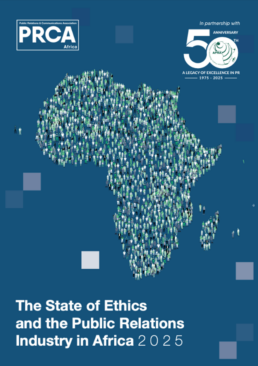
New Report Reveals What’s Driving Public Relations in Africa Today

New Report Highlights Ethics and Digital Transformation as Key Drivers of Africa’s Evolving Public Relations (PR) Industry
Last week, the African Public Relations Association (APRA), which is celebrating its 50th anniversary this year, together with the Public Relations and Communications Association (PRCA), unveiled the latest findings of their annual research into ethics and the public relations (PR) landscape across the continent. The results were presented at the APRA conference, which took place in Mombasa, Kenya. The research was conducted by leading African reputation research consultancy, Reputation Matters.
Now in its sixth consecutive year of tracking ethics and the fourth of mapping the broader PR landscape, the study continues to provide valuable insights into the trends shaping communication across Africa. For the second year running, the research also explored attitudes towards artificial intelligence (AI) and the evolving digital landscape.
This year’s study drew responses from 313 professionals across 24 African countries, representing the broadest regional participation to date. South Africa contributed 30% of responses, followed by Kenya (17%), Nigeria (16%), and Cameroon and Mauritius (7% each). Every response offers rich, contextual insight, reinforcing the diverse and dynamic nature of Africa’s communications landscape.
The results highlight a profession adapting to rapid technological change while reaffirming its ethical foundations. Long-standing challenges, such as underrepresentation at board level and the undervaluing of evaluation and measurement, remain prominent. At the same time, new ethical concerns are emerging as technology accelerates communication at an unprecedented pace.
Key insights from the 2025 research include:
Ethics under scrutiny: Corruption remains the most frequently cited ethical challenge across the countries represented in the study. Respondents noted that broader societal issues such as cultural norms, social injustice, and weak enforcement mechanisms continue to impact public trust and institutional credibility.
AI and ethics in tandem: 69% of participants see AI as a tool to enhance, not replace, PR practice. However, concerns about misinformation, manipulation, and the responsible use of emerging technology are widespread.
Boardroom influence slowly improving: While 40% of respondents believe PR is still undervalued at board level, 38% report that business leaders now rely more heavily on PR counsel, a notable rise from 31% in 2024.
Training gaps persist: There is ongoing demand for professional development, particularly in strategic communication, crisis management, and reputation management.
PR’s resilience and reach: Although overall response numbers dipped slightly from 2024, the increased regional diversity points to growing sector maturity and a shared belief in PR’s ability to build trust during times of reputational and governance challenge.
Arik Karani, President of APRA, said, “In an era where trust is fragile, the value of ethical public relations has never been clearer. This report shows both the urgency and the opportunity for PR professionals to lead with integrity.”
Sarah Waddington CBE, Interim CEO of PRCA, added, “While optimism is encouraging, it must be matched with a firm commitment to ethics, accuracy, and responsible AI deployment. This year’s research confirms that our industry is increasingly aware of its responsibilities, but much work remains to embed trust at every level. At the PRCA, we remain steadfast in our commitment to guiding the profession through clear standards and support to ensure that ethical principles underpin every use of emerging technologies.”
The report outlines three pillars on which Africa’s PR future is being built: ethical clarity, strategic credibility, and a commitment to continual growth.
Regine le Roux, Managing Director of Reputation Matters, added, “This year’s findings remind us that PR is not just about managing perception. It is about building trust, standing for what is right, and growing together. In an era where digital communication travels faster than ever before, our responsibility as communicators has never been greater. We are the stewards of truth in a time of miscommunication, and the custodians of clarity in a world clouded by confusion.”
“Let us keep moving forward, with integrity in our purpose, with compassion in our storytelling, and with courage in our leadership. When PR is done with heart, it does more than shape brands. It becomes a voice for change. It shapes futures and serves as a force for transformation across Africa.”
“We are deeply grateful to APRA and PRCA for their continued commitment to advancing the profession through research. Their investment in this annual research is setting the standard for ethical leadership and knowledge-sharing across the continent. It is this kind of collaboration that elevates our industry and strengthens our collective impact.”
To further explore the 2025 findings, PRCA Africa and APRA will host a live panel discussion through the Ethics and Practices Network. The session will delve into key insights from the report and reflect on the role of ethics in a digitally transforming world.
Date: Thursday, 19 June 2025
Time: 12:00 to 13:00 SAST
Attendance is free, and all industry professionals are welcome.
Register here: Zoom
https://us02web.zoom.us/webinar/register/WN_Nn2V-1mWQbqnCWVf-y0QBg.
For more information about the PRCA Africa Ethics and Practices Network, visit:
https://www.prca.global/about-us/global/prca-africa/prca-africa-networks/prca-africa-ethics-and-practices
###
For more information on APRA: http://www.afpra.org/
More information on PRCA: www.prca.global
More information on Reputation Matters: www.reputationmatters.co.za
Media contact:
Regine le Roux
regine@reputationmatters.co.za
083 302 1528

Crisis Comms 101: Don’t Just Run to the Lawyers

Caption: Criticism calls for communication, not courtrooms. Crisis Communication 101: What the Two Oceans Marathon saga teaches us about public relations, dialogue, and defending reputation the right way.
When a crisis hits, the first response should not always be legal. More often than not, a situation can be diffused — or even turned into an opportunity — through timely, transparent, and empathetic communication.
A quick summary of the Two Oceans Marathon and blogger saga: Two Oceans Marathon organisers have taken legal action against running blogger Stuart Mann (The Running Mann) following a series of critical posts highlighting various organisational concerns. These included issues such as medal shortages, insufficient water points, changes to Blue Number Club seeding, and a general lack of timely communication with participants. Rather than responding publicly to the questions raised, the organisers opted for a legal route; a decision that has sparked widespread concern and debate within the South African running community.
For many runners, myself included, the Two Oceans Half Marathon is a big, hairy, audacious goal. Completing 21 km is a monumental achievement; the catalyst that often sparks a lifelong love for running, and for some, may eventually lead to a marathon or even the Ultra. That is why the race holds such a special place in so many hearts; it is more than just a run; it is a rite of passage.
This year, I ran the Two Oceans Half for the first time in years and was struck by how much more negative sentiment there was around the race compared to when I first participated.
In the lead-up to race day, I came across The Running Mann’s blog. The first post that caught my eye was about the Blue Number Club. I was drawn to it because a friend of mine was celebrating her tenth Two Oceans. It’s a remarkable milestone that earns a Blue Number and truly deserves recognition and, was disappointed with her, about the seemingly small things that were decided no longer to be included, e.g. preferential seeding. His post raised valid, constructive questions; and that’s what prompted me to start following his writing more closely.
But it quickly became clear —not just from that blog, but from comments by other runners — that something felt amiss with this year’s organisation. Many pointed to a lack of communication as a key concern. Of course, there will always be the usual handful of grumbles in any big event, but this felt different. The volume and tone of the complaints suggested something deeper, perhaps a long-standing frustration bubbling up and spilling into even the smaller details.
I’ve always compared building running stamina to building reputation stamina. You need a goal, a training plan, and consistent effort. You need to track your progress, surround yourself with the right people, fuel wisely, and use the right tools. When you’re fit and healthy, you recover faster from setbacks. The same applies to your reputation. When your organisation has built reputation stamina, through consistent behaviour, clear values, ongoing tracking, and the right people, it’s far better equipped to handle difficult moments. A solid reputation gives you that all-important fuel in the tank when you need it most.
Your brand is what you say about yourself. Your reputation is what others say about you. Your reputation is shaped by your behaviour and rooted in your values.
Two Oceans is an institution with an enviable legacy. Its reputation was not built overnight, and it certainly will not disappear overnight either. Despite the criticism, I know many runners will still line up next year. But if the quality continues to slip, and its reputation stamina isn’t maintained, it risks losing its iconic status.
People associate with brands they believe in, and they want to feel seen, heard, and valued. They pay their hard-earned money not just to run, but to belong. And the race starts long before the gun goes off: from registration, to number collection, to the final medal. Every touchpoint counts.
Something to keep in mind: it is not just leadership that shapes a reputation. Everyone in the team contributes to it.
What Two Oceans Could Have Done Differently (Before Going Legal):
- Call a Communicator Before a Lawyer.
Involving a reputation or communication advisor early on could have helped diffuse tension. You can build reputation during a crisis. A legal letter often shuts the door to meaningful dialogue. - Be Empathetic.
“We hear you. We’re sorry. We can do better.” These are not admissions of guilt, they are acknowledgements of community. People want to feel seen and heard, not stonewalled. - Respond to the Questions.
Many of The Running Mann’s questions were fair. Ignoring them creates more frustration. Even if you do not have all the answers — say so. Silence speaks volumes, and not in a good way. - Be Proactive.
If things did not go according to plan, admit to it. Thank participants, acknowledge what went wrong, and commit to doing better. Celebrate the wins too, but, be honest about the hiccups. - Deal with Issues Early.
Do not let a trickle of complaints become a tidal wave. Communicate early and often. - Keep It Simple.
Responses do not need to be lengthy or complicated. Short, clear, and timeous answers build trust. - Take the Criticism on the Chin.
People care — that is why they are vocal. They want the race to be the best it can be.
Next Steps for TOM (and Others Watching)
- Review what worked — and what didn’t.
Be honest. Then take the time to strategise and plan how to do things differently next time. Improvement starts with reflection, followed by action.
- Reconsider the legal route.
Consider whether pursuing legal action is the wisest use of the NGO’s funds, or whether open, honest dialogue might better serve the organisation’s long-term reputation.
- Invest in communication and governance training.
Equip the board with the tools and insight needed to respond effectively, transparently, and with accountability.
- Keep your stakeholders in the loop.
Proactive, clear communication builds trust. Let people know what’s happening, even if the answer is “we’re still working on it.”
Let’s not outrun communication.
Reputation, like running, is built through consistency, resilience, and listening to the rhythm of those around you.
The race belongs to the runners. The responsibility belongs to the organisers. Let’s honour both with empathy, clarity, and care.
In moments of criticism, strength lies not in defence, but in dialogue.
###

South Africa: The Friendliest Country in the World? A Reputation Worth Embracing

South Africa has been crowned the friendliest country in the world in a recent global study by international money transfer service Remitly. Now isn’t that some incredibly positive news that we can all do with! While this news has been met with both celebration and scepticism, it raises a powerful question: What does this kind of international recognition mean for South Africa’s reputation?
A Reputation Built on Heart
Personally, I think it’s incredible news! I know not everyone may agree — and that’s fair. But I prefer to err on the side of positivity. After reviewing the methodology, I saw it was based on feedback from around 3,000 participants. I would be curious to know more about the sample — where were the participants from, and were the country options open-ended or predefined?
What did surprise me was that more African countries didn’t feature on the list. Having had the privilege of travelling across our beautiful continent, I’ve experienced first-hand the warmth and friendliness Africa has to offer. That said, I’m proud that South Africa has received this recognition — it’s a reflection of the heart that underpins our identity.
Why This Matters for Our National Brand
Recognition like this gives our national brand a valuable boost. At Reputation Matters, we often remind clients that a brand is what you say about yourself, whereas a reputation is what others say about you.
Despite the very real issues we face — from crime and unemployment to inequality — this moment serves as a reminder that South Africa’s character is defined by more than its challenges. As South Africans, we are often our own harshest critics. That’s why it’s important to pause and celebrate moments like these. They highlight the resilience and friendliness that quietly but consistently shape who we are.
Friendliness, Ubuntu and Global Reputation
A strong reputation isn’t built on a single study or feel-good headline — it’s built through consistent, authentic behaviour over time. Still, being recognised for something like friendliness is a powerful affirmation.
Ubuntu — the spirit of “I am because we are” — runs deep in our national DNA. Even when faced with adversity, the way we interact, the way we show care, and the small kindnesses exchanged daily all shine through.
Friendliness isn’t just a feeling. It’s a behaviour — a reflection of the values that guide us — and that matters when it comes to building a global reputation that’s not only strong, but human.
The Power of Balanced Storytelling
So how do we ensure that we keep building a credible reputation — one that celebrates the good while acknowledging the work that still lies ahead?
The key lies in balance. We must continue sharing stories of hope, kindness, and innovation alongside the real stories of the challenges we face. Platforms like Good Things Guy are wonderful examples of how we can shift the narrative without ignoring the truth.
It’s also a reminder that building a better South Africa is not only government’s responsibility — it’s up to all of us. Every small act of kindness, every effort to uplift, every story we choose to share contributes to the bigger picture.
A Reputation We Can All Be Proud Of
I’m thrilled that South Africa has been recognised as the friendliest country in the world. It’s a refreshing reminder of the heart, humour, and humanity that continue to define us. While we must acknowledge our challenges, we also need to hold space for the good — and celebrate it loudly.
Because in the end, reputation isn’t built in boardrooms. It’s built in everyday behaviour. And that’s where South Africa truly shines.
###

Ethics and PR Landscape in Africa Survey 2025

The Public Relations and Communications Association (PRCA) Africa, in collaboration with the African Public Relations Association (APRA), is thrilled to announce the launch of its fourth annual study, marking the third year of their partnership. This year’s research, carried out by Reputation Matters, delves into the evolving landscape of PR and communications across Africa.
The flagship study aims to capture comprehensive demographic data on the industry while exploring critical issues such as ethical practices, PR's role in business, talent management, remote work, and future challenges.
PR professionals across Africa are invited to participate in the survey, which takes just a few minutes to complete, with all responses remaining confidential. The results will be unveiled at the annual APRA Conference, taking place in Mombasa, Kenya, later this year.
PRCA International Director Melissa Cannon MPRCA commented:
“This collaborative effort with APRA provides a valuable opportunity to compare recent changes in the African PR landscape with previous years and forecast the challenges that lie ahead. By examining current trends and shifts, we aim to gain a deeper understanding of the industry's evolution and better prepare for the future.”
Arik Karani, President of APRA shares:
"At APRA, we believe in the power of unity and collaboration across the continent. By leveraging research and best practices, we can strengthen the PR industry in Africa and create a more ethical, transparent, and impactful profession. This study is a vital step toward understanding our diverse landscape and working together as one Africa to address the challenges and opportunities that lie ahead."
Regine le Roux, founder and managing director of Reputation Matters says:
"It is encouraging to see the emphasis that APRA and the PRCA are placing on research, truly leading by example. Research is critical not only for strategic communication development but also for securing a seat at the boardroom table by speaking the language of the C-suite—numbers. We are eager to gain deeper insights from communicators across the continent into ethics and better understand the PR landscape, so we can unite and move forward as one Africa."
Access the survey, available in both English and French, here.
For any additional information, please do not hesitate to contact Reputation Matters: research@reputationmatters.co.za / +27 83 302 1528
###
